
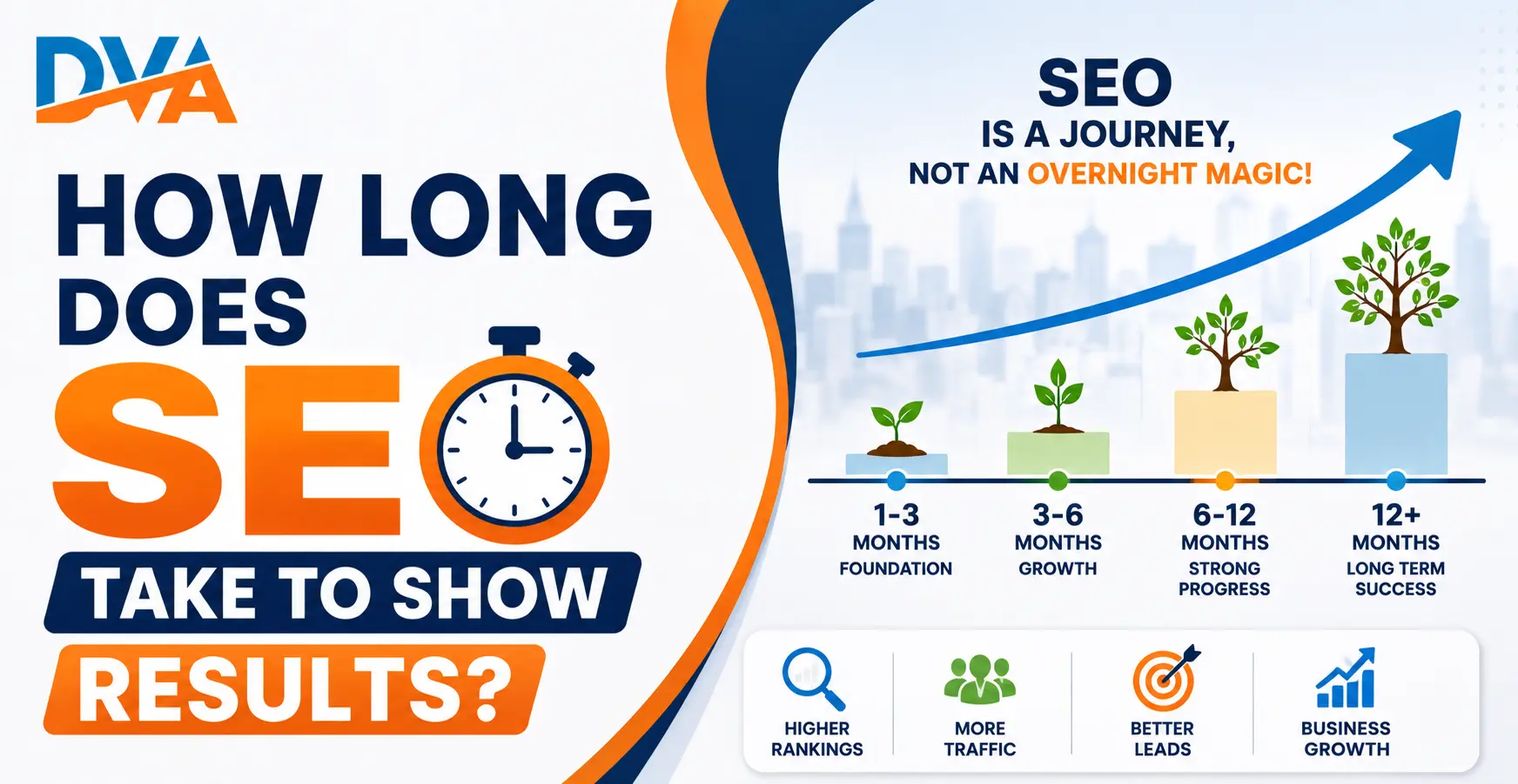
Most websites start seeing measurable SEO results within 3 to 6 months of consistent effort. New websites may need 6 to 12 months. Local SEO, especially Google Business Profile rankings, can show movement within 4 to 8 weeks. The exact timeline depends on your website’s age, the competition in your niche, the quality of your content, and how consistently you work on SEO each month.
SEO is not a switch you flip. It is a process that builds over time. The first 3 months are mostly invisible, the next 3 months start showing signals, and from month 6 onwards, results compound. Expecting instant results is the most common reason people give up on SEO too early.
This is the number one question most people ask before starting SEO. It is also the question most SEO articles answer vaguely with “it depends.” This guide gives you specific, realistic expectations backed by real data, so you can plan your SEO effort properly and know what to watch for each month.
If you are new to SEO, it helps to first understand what SEO is and how it works before setting timeline expectations. But if you already know the basics, let us get into the honest answer.
Why Does SEO Take So Long?
Think of SEO like planting a fruit tree. You prepare the soil, water it consistently, and wait for it to mature. The tree does not give fruit in the first week. But if you stop watering it, you never get fruit at all. Websites that rank on page one did not get there overnight. They earned it through consistent effort over time.
A key study by Ahrefs found that 96.55% of all pages get zero organic traffic from Google. The pages that do get traffic share one thing in common: they have earned trust, backlinks, and topical depth that most other pages never build. That takes time and consistent work.
New websites also face what is sometimes called a sandbox period, an informal term describing the delay Google applies to newer domains while it evaluates credibility and content consistency. This is not a confirmed Google policy, but most SEO professionals observe that new sites take longer to rank even with strong content in place.
What Is the Realistic SEO Timeline? (Month-by-Month Breakdown)
| Month | What Is Happening | What to Track |
|---|---|---|
| Months 1-2 | Technical fixes, keyword research, content plan, sitemap submission, on-page optimisation | Crawl errors, indexing status in Search Console |
| Months 3-4 | First impressions appear, long-tail keywords enter positions 10-50, traffic very low but growing | Search Console impressions, average position |
| Months 5-6 | Consistent organic traffic begins, first top-10 rankings for specific queries, ROI starting to appear | Organic clicks, keyword positions, leads |
| Months 7-12 | Compounding gains, stronger rankings, older pages earning backlinks, topical authority building | Sessions, bounce rate, conversion rate |
| 12 Months+ | Brand authority established, consistent inbound traffic, competitive keywords becoming achievable | Revenue, leads, market share |
These timelines assume consistent monthly work: publishing new content, fixing technical issues, earning backlinks, and monitoring Search Console. Doing SEO for two months and then stopping is one of the most common reasons results never materialise.
New Website vs. Established Website: How the Timeline Differs
An established website that has been publishing content for 2 or more years has one major advantage: domain trust. Research from Ahrefs shows that the average page ranking in position one on Google is approximately 5 years old. This does not mean a new page cannot rank quickly, but the data shows that older, trusted pages hold a structural advantage.
If you are starting a brand-new website, this is not a reason to delay. Every established website was once new. The difference is they started. The key is to target low-competition, long-tail keywords in the early months rather than going after broad competitive terms you cannot win yet.
Rated by Students
4.9/5 Rating. 500+ Students Trust Digital Vishnu Academy for Their Career
Practical training. Real projects. Placement assistance that actually works.
What Factors Make SEO Take Longer?
Here are the most common reasons SEO takes longer than expected:
- New domain with no history: Google takes time to establish trust in new websites. There is no shortcut for this, only consistent effort over time.
- Targeting competitive keywords too early: Going after broad terms like “digital marketing” before you have authority rarely produces early results. Long-tail keywords build momentum first.
- Poor technical SEO: Crawl errors, slow load times, and mobile issues prevent Google from properly reading your pages. Fix these before creating more content. Our technical SEO guide for beginners covers the essentials.
- Thin or generic content: Pages that give shallow, vague answers do not satisfy search intent. They get crawled and then deprioritised over pages that give complete, specific answers.
- No backlinks: Pages with no external links pointing to them lack credibility signals. Earning even a few quality backlinks from relevant sources makes a measurable difference.
- Inconsistent effort: Publishing 10 posts and then pausing for 3 months sends no positive signal to Google. Consistency over time matters more than bursts of activity.
Local SEO vs. Broader SEO: Two Different Timelines
If you run a local business in Coimbatore or anywhere in Tamil Nadu, this distinction is important. Local SEO has two separate ranking systems. The first is the Google Maps local pack, the three-business box at the top of local searches. The second is the regular website rankings below it. These two systems move at different speeds.
Optimising your Google Business Profile, collecting genuine reviews, building local directory citations, and posting updates regularly can shift your Maps rankings within weeks. This is why local businesses often see early SEO wins before their website keyword rankings improve.
For website rankings on local queries like “digital marketing course in Coimbatore,” the same 3 to 6 month timeline applies. But local competition is typically lower than national competition, so results often come faster for local queries. Combining strong on-page optimisation with an active Google Business Profile is the fastest route to local visibility.
What Should You Track While Waiting for SEO Results?
The biggest mistake people make during the first 3 months is checking keyword rankings daily and concluding SEO is not working. Rankings fluctuate constantly in the early months. Instead, track leading indicators that signal progress before rankings stabilise.
Track these four metrics in Google Search Console every month:
- Impressions: The number of times your pages appeared in search results, even without a click. Rising impressions are the first sign Google is indexing and considering your pages for queries.
- Average position: If your average position moves from 55 to 35 over several weeks, that is real progress, even though you are not on page one yet.
- Clicks: These follow impressions with a lag. Do not worry if clicks are near zero in the first 2 to 3 months.
- Indexed pages: Confirm that your new pages are being indexed. If a page is not indexed, it cannot rank regardless of its quality.
Set a monthly review date. Compare this month against last month on all four metrics. If impressions and average position are both improving month over month, your SEO is working, even if it is not yet visible in traffic numbers.
How to Speed Up Your SEO Results Without Shortcuts
There are no legitimate shortcuts in SEO. Buying backlinks, keyword stuffing, or using AI-generated filler content may produce brief movement but typically leads to ranking drops or penalties. The fastest legitimate path to SEO results follows these five priorities:
- Fix technical issues first. A crawlable, fast, mobile-friendly website lets Google index your content quickly. Technical problems delay everything downstream.
- Target long-tail keywords in the first 3 months. A new website cannot win “digital marketing” in month one. But “digital marketing course for working professionals in Coimbatore” is a winnable query much sooner.
- Publish content consistently. Weekly or bi-weekly publishing builds topical authority and gives Google more pages to evaluate. Irregular publishing breaks momentum.
- Earn backlinks from relevant sources. Guest posts on relevant local or industry blogs, local directory listings, and citations from Tamil Nadu business associations all accelerate trust signals.
- Update existing pages before creating new ones. Refreshing older content with new data, better structure, and clearer answers often produces faster ranking improvements than writing entirely new pages.
Using a solid on-page SEO checklist for every new page and combining it with consistent off-page SEO work is the most reliable way to shorten the timeline without taking risks.
Conclusion
SEO takes time, and that is not a flaw, it is how the process works. The 3 to 6 month timeline is not a reason to wait before starting. It is a reason to start now. Every month you delay is a month further from results.
Focus on what you control: your technical foundation, your content quality, your keyword targeting, and your consistency. Results follow when these are in place and maintained over time. The websites that rank well are simply the ones that did not stop.
If you want to learn SEO from scratch in a structured, practical way and start making progress faster, explore our SEO course in Coimbatore. You will learn how to do keyword research, write content that ranks, fix technical issues, and track your results from day one.
Frequently Asked Questions
How long does SEO take for a brand new website?
A brand new website typically needs 6 to 12 months to see consistent SEO results. New domains lack the trust signals, backlinks, and indexed content history that Google uses to evaluate credibility. Targeting long-tail, low-competition keywords from the start and publishing content consistently helps shorten this timeline.
Can I see SEO results in 1 month?
It is possible to see early signals in one month, such as pages being indexed and first appearing as impressions in Google Search Console. But meaningful organic traffic in one month is rare unless the website already has authority, the keyword is very low competition, or local SEO tactics like Google Business Profile optimisation are being used.
Is local SEO faster than regular SEO?
Yes. Local SEO, especially Google Business Profile and Google Maps optimisation, can show improvements within 4 to 8 weeks. This is faster than standard website keyword rankings, which take 3 to 6 months. For businesses in less competitive local markets like tier-2 Indian cities, local SEO results tend to arrive faster than in large metros.
What is the biggest mistake people make while waiting for SEO results?
The biggest mistake is stopping SEO activity after 2 to 3 months because results are not visible yet. SEO builds over time, and stopping early means the foundation you laid never compounds into rankings. Consistency over 6 to 12 months is what separates websites that rank from those that never break through.
How do I know if my SEO is working before I see traffic?
Track impressions and average position in Google Search Console monthly. Rising impressions mean Google is finding and considering your pages. An average position improving from 50 to 30 over several weeks signals real movement, even before click-through traffic becomes visible. These leading indicators confirm SEO is working before the results are obvious.