
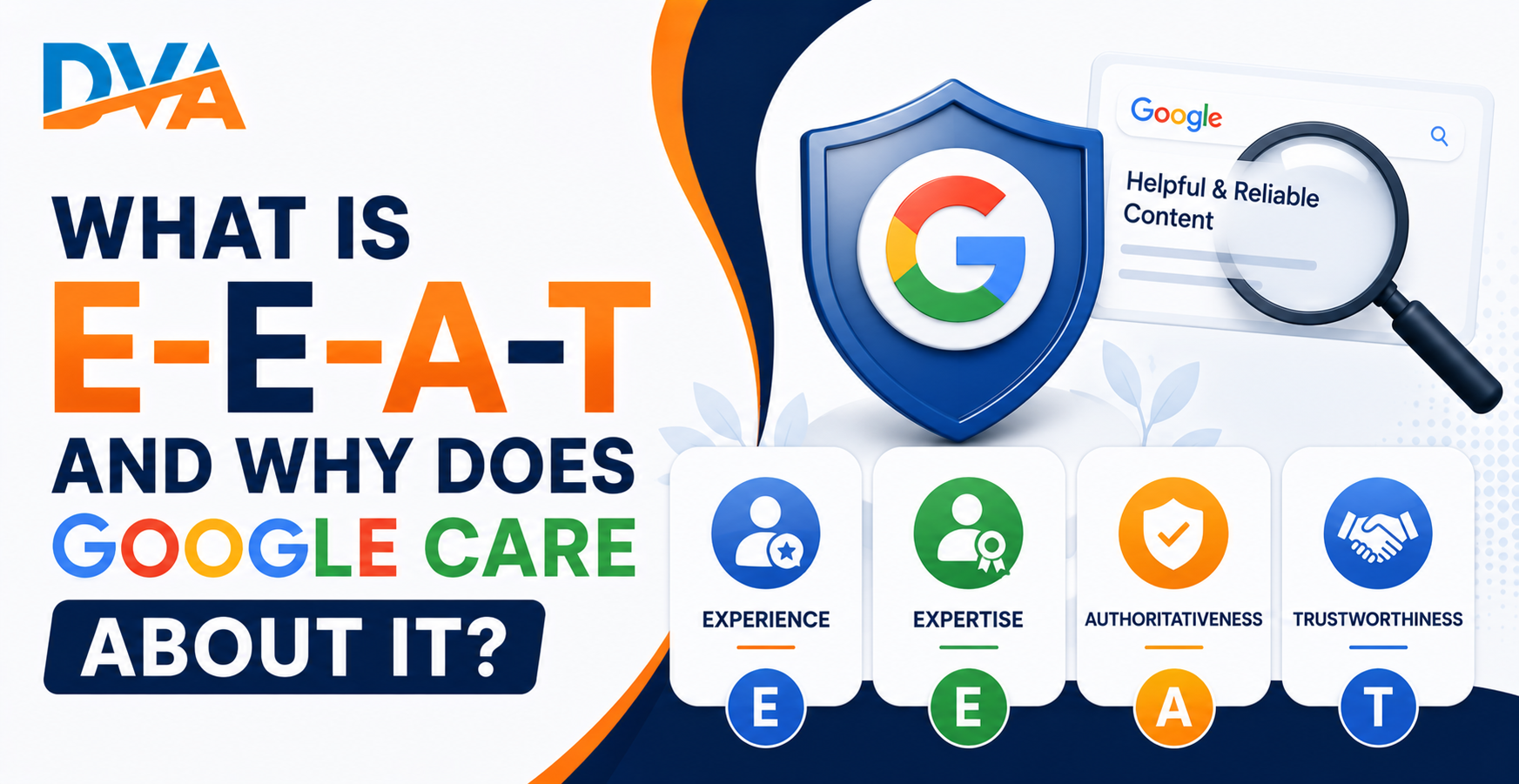
E-E-A-T stands for Experience, Expertise, Authoritativeness, and Trustworthiness. Google uses this framework to evaluate whether a page is created by someone with real knowledge, first-hand experience, and a credible reputation. Pages that demonstrate strong E-E-A-T signals are more likely to be seen as high quality and surfaced in search results. Understanding E-E-A-T helps you understand what Google is actually looking for when it ranks content.
E-E-A-T is not a direct ranking factor in Google’s algorithm. It is the quality standard Google’s human reviewers use to evaluate whether content is genuinely helpful and credible. When your content consistently demonstrates real experience, genuine expertise, and honest, accurate information, it tends to align with what Google’s ranking systems reward.
Google’s most basic job is to return the most helpful, accurate, and trustworthy result for every query. To do this at scale, Google needs a way to evaluate the quality of every page it indexes. E-E-A-T is the framework that describes what quality looks like.
This guide explains what each part of E-E-A-T means, why Google developed this framework, and how you can improve your website’s E-E-A-T signals in practical terms.
What Does Each Letter in E-E-A-T Stand For?
Here is what each letter means in plain terms:
- Experience — Does the person who created this content have first-hand or real-world experience with the topic? A product review written by someone who has actually used the product carries more weight than one assembled from other reviews. A travel guide written by someone who visited the destination is more credible than one compiled from secondary sources.
- Expertise — Does the creator have the knowledge, skills, or qualifications needed to produce accurate, reliable information on this topic? A medical article written by a qualified doctor carries different weight than one written by someone with no background in medicine.
- Authoritativeness — Is the creator or the website recognised as a credible source for this subject? Authority is built over time through consistent quality content, relevant mentions, citations, and backlinks from other trusted sources in the same field.
- Trustworthiness — Is the page, the website, and the creator honest and transparent? Trust signals include clear authorship, accurate information, secure HTTPS, a visible privacy policy, honest disclosure of affiliations, and straightforward contact information.
Google added the first E, for Experience, in December 2022. Before that, the framework was known as E-A-T. The addition of Experience reflects Google’s emphasis on content that demonstrates genuine, lived knowledge of a topic rather than content that merely aggregates information from other sources.
Why Did Google Create E-E-A-T?
Google employs thousands of search quality raters around the world. These human evaluators do not directly change rankings. Instead, they assess whether Google’s algorithm is surfacing useful, credible results. Their ratings are used to improve how the system identifies and rewards quality.
Quality raters work from a detailed public document called the Search Quality Evaluator Guidelines. E-E-A-T is the central quality standard in that document. If Google’s ranking systems consistently surface pages that quality raters score highly for E-E-A-T, it is a sign the algorithm is working well. If it surfaces low E-E-A-T pages, the algorithm needs adjustment.
This is why E-E-A-T is not a direct algorithmic ranking factor in the way keyword relevance or page speed are. It is a description of the quality that Google’s systems are designed to reward. Content that consistently demonstrates strong E-E-A-T tends to perform better in search because it aligns with what Google is optimising towards. According to Google’s Search Central Blog, the addition of Experience was specifically intended to recognise that content demonstrating first-hand knowledge adds a quality dimension that theoretical expertise alone does not capture.
What Are YMYL Pages and Why Do They Need Higher E-E-A-T?
Examples of YMYL content include:
- Medical advice pages covering symptoms, diagnoses, or treatments
- Financial guidance covering investment, loans, or insurance
- Legal information covering rights, contracts, or taxation
- Safety and emergency information
- News pages covering significant current events
- Pages giving personal safety, parenting, or mental health advice
For YMYL content, Google expects a higher level of verified expertise and accountability. A medical article should ideally be written or reviewed by a qualified health professional. A financial advice page should make clear the credentials of the person or organisation responsible for the advice.
For non-YMYL content — such as recipes, digital marketing guides, hobby content, or product comparisons — the E-E-A-T bar is more achievable. Demonstrated experience and genuine knowledge are sufficient, even without formal qualifications. A digital marketing blog run by an experienced practitioner can demonstrate strong E-E-A-T without the author holding a formal academic credential in marketing.
Rated by Students
4.9/5 Rating. 500+ Students Trust Digital Vishnu Academy for Their Career
Practical training. Real projects. Placement assistance that actually works.
How Does Google Evaluate E-E-A-T Signals?
On-page signals Google looks at:
- Clear author attribution with a real name and relevant background
- An accurate, complete About page describing the organisation or person
- Transparent contact information and a visible privacy policy
- Clear dates showing when content was published and last updated
- Structured data such as Article, Person, and Organisation schema
- Specific, accurate information that goes beyond surface-level coverage
- Cited sources for factual claims
Off-page signals Google looks at:
- Backlinks and citations from credible, topically relevant websites
- Brand mentions in news publications, industry journals, professional directories, and forums
- Verified business listings in Google Business Profile and other established directories
- Author profiles visible on external platforms such as LinkedIn, industry associations, or respected publications
The key distinction is that E-E-A-T is not built by any single action. It is the cumulative picture that Google assembles from everything it can observe about your content, your authors, and your website’s standing in your topic area. Google’s How Search Works explains how quality assessment feeds into the broader process of determining which pages serve search queries best.
How to Improve E-E-A-T on Your Website
1. Add proper author bios to every article
Every article should display a named author with a short bio explaining their relevant experience or qualifications. Even two sentences about the author’s background adds credibility. Link to the author’s LinkedIn profile or published work where available.
2. Build a credible About page
Your About page should clearly explain who you are, what you do, how long you have been doing it, and why you are a credible source on your topic. For a business, include your registration details, physical location, team information, and a clear contact method.
3. Cite credible sources for factual claims
When you state a fact that can be verified, link to the primary source. Government pages, official research publications, and recognised industry bodies are strong sources. Citing good sources signals to both readers and Google that you are not simply asserting things without support.
4. Keep content accurate and up to date
Outdated information damages trust. Display a last-updated date on articles. Revisit older posts regularly and correct or remove information that is no longer accurate. Google’s systems can identify when content has become stale relative to what other authoritative sources say on the same topic.
5. Build your off-page reputation through genuine links and mentions
Seek genuine backlinks from credible websites in your field. Contribute guest posts to respected publications. Get your business listed in verified directories. Participate in professional communities where your expertise is visible. This builds the external recognition that Google uses to verify authoritativeness.
6. Use structured data to make your authorship and organisation clear
Add Article, Person, and Organisation schema to your website. Structured data helps Google understand who created the content, what the organisation behind it is, and what the page covers. This supports the E-E-A-T picture Google builds about your site and its content.
Our on-page SEO checklist covers the specific elements to review and implement on every page, many of which directly support your E-E-A-T signals.
It is also worth noting that E-E-A-T has become more important in the age of AI-generated content. As more websites publish AI-assisted text at scale, the signals that distinguish genuine expertise from assembled content — real author bios, cited sources, specific practical knowledge — carry increasing weight. Our post on how AI is changing search in 2026 explains how E-E-A-T fits into the broader AI era SEO landscape.
E-E-A-T Requirements by Content and Website Type
| Content Type | Experience Needed | Expertise Level | YMYL? |
|---|---|---|---|
| Medical / health advice | Professional or patient experience | Qualified professional preferred | Yes — high standard |
| Financial / legal advice | Professional experience required | Qualified / regulated professional | Yes — high standard |
| Digital marketing guides | Practical industry experience | Demonstrated knowledge and practice | No — moderate standard |
| Product reviews | Direct use of the product | User or expert experience | Partial — depends on product type |
| Recipe / hobby content | Personal practice and enthusiasm | Genuine interest and skill | No — lower standard |
| Local business pages | Business owner / team knowledge | Operational business expertise | Partial — depends on services offered |
E-E-A-T is not a shortcut, and it is not a single thing you switch on. It is the accumulated picture that Google builds of your website, your content, and the people behind it. The best approach is to consistently publish accurate, genuinely useful content that is clearly attributed to real people with real knowledge, cited properly, and kept up to date.
If you want to learn how to build credible, search-quality content and develop a digital marketing strategy grounded in real expertise, our SEO course in Coimbatore and digital marketing course give you the practical skills to do it right from day one.
Frequently Asked Questions
What is E-E-A-T in SEO?
E-E-A-T stands for Experience, Expertise, Authoritativeness, and Trustworthiness. It is the quality framework Google uses to evaluate whether a webpage and its creator are credible, knowledgeable, and reliable. Google’s human quality raters use E-E-A-T to assess search results, and Google’s ranking systems are designed to reward pages that demonstrate strong E-E-A-T signals consistently over time.
Is E-E-A-T a direct Google ranking factor?
No, E-E-A-T is not a direct ranking factor in the way page speed or keyword relevance are. It is the quality standard in Google’s Search Quality Evaluator Guidelines. Google’s ranking systems are designed to surface pages that align with these standards, so strong E-E-A-T indirectly influences search performance. You cannot improve a single E-E-A-T score because it is not calculated as a numeric value — it is a holistic assessment.
When did Google add the second E to E-E-A-T?
Google added the second E, which stands for Experience, in December 2022. Before that, the framework was called E-A-T. The update reflected Google’s growing emphasis on content created by someone with real, first-hand knowledge rather than content that assembles information purely from secondary sources. Experience signals include things like product reviews written by actual users and travel guides written by people who visited the location.
What are YMYL pages?
YMYL stands for Your Money or Your Life. These are pages that could significantly affect a person’s health, finances, safety, or legal situation, such as medical advice, financial guidance, or legal information. Google applies a higher E-E-A-T standard to YMYL pages because inaccurate or low-quality content in these areas can cause genuine real-world harm. Non-YMYL content like recipes or digital marketing guides faces a lower but still meaningful E-E-A-T standard.
How can a small business improve its E-E-A-T?
A small business can improve E-E-A-T by adding named author bios to content, building a credible and detailed About page, citing reliable external sources for factual claims, earning genuine backlinks from trusted local and industry websites, keeping content accurate and current, and maintaining a verified Google Business Profile listing. These steps build both the on-page and off-page signals that contribute to how Google perceives the site’s credibility.
Does E-E-A-T apply to small or local websites?
Yes, E-E-A-T applies to all websites including small and local ones. For a local business in Coimbatore, E-E-A-T signals include having a verified Google Business Profile, clear contact and location information, a well-written About page, and accurate service descriptions. The standard is appropriate to your topic and audience. You do not need international authority to have strong E-E-A-T — you need credible, accurate, well-attributed content relevant to the people you serve.