
TL;DR
Prompt engineering is the skill of writing clear, structured instructions for AI tools like ChatGPT and Gemini to get high-quality marketing outputs. Digital marketers who master this skill create content faster, write sharper ad copy, and plan smarter campaigns. You do not need any coding knowledge to start. Learn the 5 core elements of a great prompt and use the 10 ready-made templates in this guide to improve your AI results starting today.
Most digital marketers have tried ChatGPT at least once. But many walk away disappointed because the output felt generic, off-brand, or simply unusable. The problem is almost never the AI tool itself. It is the prompt.
Prompt engineering for digital marketers is the skill of writing instructions that tell AI exactly what to produce, in what format, and for which audience. It is the difference between getting a mediocre generic paragraph and a publish-ready, on-brand section in under 2 minutes.
This guide is written for marketers who want better results from AI tools in 2026. You will learn the 5 core building blocks of a great prompt, 3 techniques professionals use, and 10 ready-to-use templates for your daily marketing tasks.
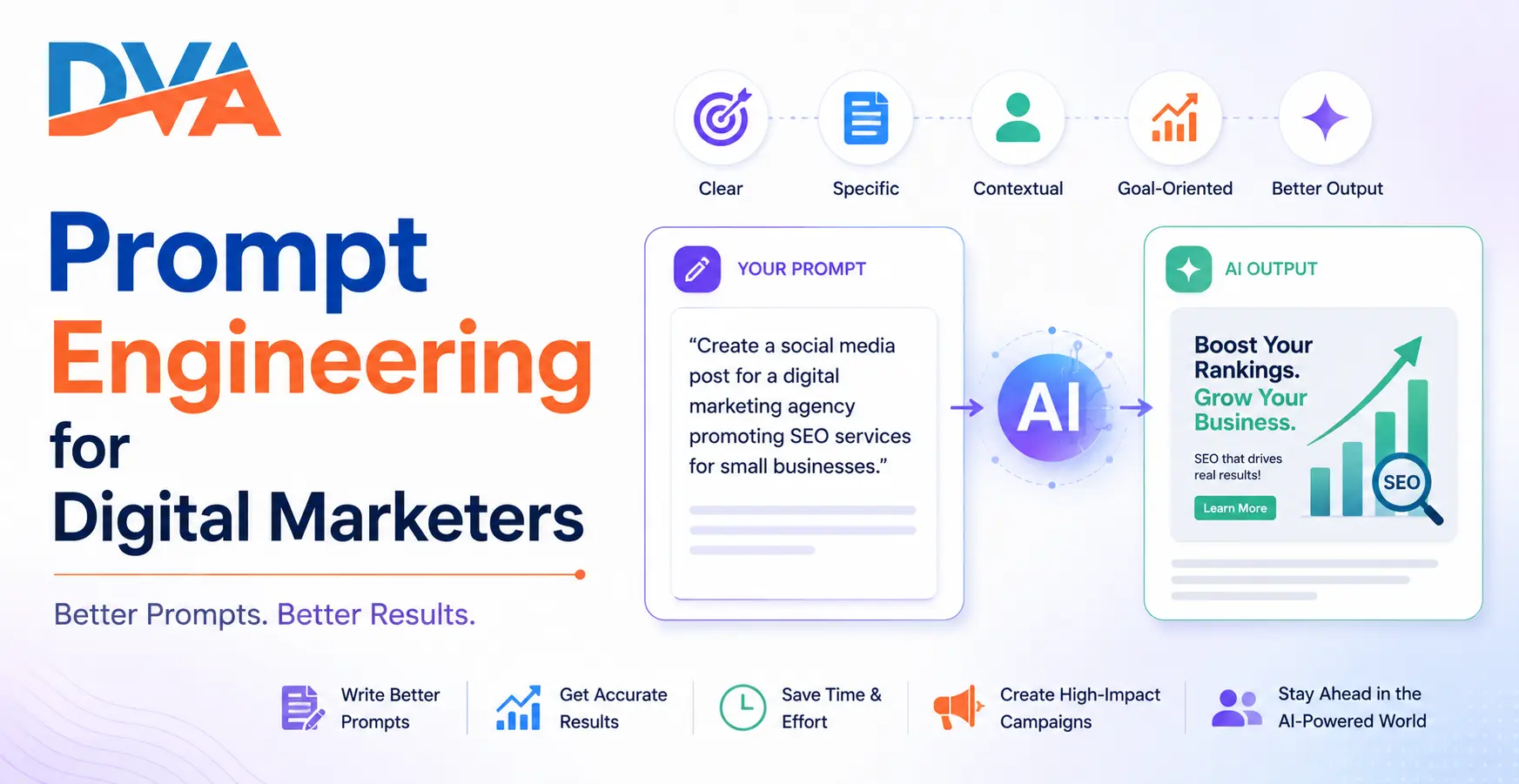
What Is Prompt Engineering?
Prompt engineering is the practice of designing clear, structured inputs that guide AI language models like ChatGPT, Gemini, or Claude to produce useful, accurate, and relevant outputs. A prompt can be a single sentence or a detailed multi-part instruction. The quality of your prompt directly controls the quality of what the AI returns.
Think of it like briefing a freelancer. A vague brief gets average work. A detailed, specific brief gets work you can actually use. AI prompts for marketing follow the same logic: more context and structure in means better output out.
According to OpenAI’s official prompt engineering guide, the most effective prompts include clear instructions, relevant context, specific output format requirements, and examples where needed. These inputs consistently produce the best results across AI marketing tasks.
Why Digital Marketers Need Prompt Engineering Skills
A 2024 HubSpot State of Marketing report found that 64% of marketers already use AI tools in their daily workflow. But most of them report inconsistent output quality and spend significant time editing AI content before it is usable. The gap between marketers who get great AI output and those who do not comes down entirely to how well they write prompts.
ChatGPT prompts for digital marketing tasks like writing ad copy, generating blog outlines, creating email sequences, or researching keywords can save 4 to 8 hours of work per week. That is only possible when prompts are structured well. A poorly written prompt means 20 minutes of editing. A well-engineered prompt produces usable output in 5 minutes.
Companies in 2026 are actively hiring marketers who can work with AI tools efficiently, not just occasionally. Prompt engineering is fast becoming a core skill alongside SEO, content writing, and paid advertising. Check out our post on top AI tools every digital marketer must know to see which tools work best with structured prompts.
The 5 Core Elements of a Perfect Marketing Prompt
Every great prompt engineering for digital marketers framework follows 5 key elements. You do not need all 5 in every prompt, but including more of them consistently produces better results.
1. Role (Persona)
Tell the AI who it should act as. This sets the expertise level and tone immediately. Example: Act as an experienced social media marketing manager with 10 years of experience in the Indian D2C space. This one addition dramatically improves the relevance and depth of the output every time.
2. Context
Give background about your brand, product, or target audience before asking for the task. The more relevant context you provide, the more targeted the output becomes. Example: My brand sells herbal skincare products targeting women aged 25-40 in Tier 2 Indian cities.
3. Task
State exactly what you want the AI to do. Use clear action verbs: write, list, create, analyze, summarize, compare. Vague instructions like help me with marketing produce vague results. Specific instructions like write 5 Instagram captions produce usable content immediately.
100% Placement Support
Get Placed After Your Digital Marketing Course at DVA Coimbatore
Resume building, interview prep, and direct company tie-ups. Real placements, not promises.
4. Format
Tell the AI how the output should look: bullet list, numbered steps, table, paragraph, JSON, or a specific word count. Example: Format the response as a table with 3 columns: Platform, Post Type, and Caption. Specifying format removes all guesswork and produces structured, ready-to-use content.
5. Tone
Specify the voice and style the output should use: professional, conversational, persuasive, empathetic, urgent, or friendly. Matching the tone to your audience dramatically reduces editing time and makes AI output feel on-brand from the first draft.
3 Prompting Techniques Every Marketer Should Know
Beyond the 5 elements, there are three specific prompting techniques that experienced AI users apply to get the best results across different types of marketing tasks.
Zero-Shot Prompting
You give the AI a direct instruction with no examples. This works well for simple, well-defined tasks. Example: Write a 50-word meta description for a blog post about digital marketing courses in Coimbatore. Use zero-shot prompting for routine tasks like meta tags, short captions, and simple summaries where AI already has strong training data.
Few-Shot Prompting
You give the AI 2 to 3 examples of the type of output you want before asking it to create one. This is the most effective technique for matching a specific brand voice or repeatable format. Example: Here are 2 subject lines I liked: [Example 1] and [Example 2]. Write 5 more in the same style for a sale email.
Chain-of-Thought Prompting
You ask the AI to think through a problem step by step before delivering a final answer. This technique improves the accuracy of complex outputs like strategy plans, competitor analysis, and full campaign briefs. Chain-of-thought prompting is especially powerful for strategy-level marketing work where accuracy matters more than speed.
10 Ready-to-Use Prompt Templates for Digital Marketers
These templates cover the most common AI prompts for marketing use cases. Copy them directly, replace the bracketed parts with your details, and paste into ChatGPT, Gemini, or Claude.
| # | Use Case | Prompt Template | Best Tool |
|---|---|---|---|
| 1 | Blog Ideas | Act as an SEO expert. Give 10 blog ideas for [niche] targeting [audience] in India. Format as a numbered list. | ChatGPT / Gemini |
| 2 | Social Caption | Act as a social media manager. Write 3 Instagram captions for [product]. Tone: friendly. Under 100 words each. | ChatGPT |
| 3 | Meta Description | Write a meta description for [topic]. Include keyword [keyword]. Under 155 characters. | ChatGPT / Gemini |
| 4 | Email Subject Lines | Act as an email marketer. Write 5 subject lines for [offer]. Make them curiosity-driven. Under 50 characters each. | ChatGPT |
| 5 | Google Ads Headlines | Act as a Google Ads expert. Write 5 RSA headlines for [product] with keyword [keyword]. Under 30 characters each. | ChatGPT |
| 6 | Blog Outline | Create a detailed 2000-word blog outline for [topic]. Include H2s, H3s, and 3 key points per section. | ChatGPT / Claude |
| 7 | Keyword Research | Give me 20 long-tail keywords for [topic] with informational intent. Audience: [audience]. Format as a table. | ChatGPT / Gemini |
| 8 | Product Description | Act as a copywriter. Write a 100-word product description for [product] targeting [audience]. Focus on benefits, not features. | ChatGPT |
| 9 | Social Media Calendar | Create a 30-day social media calendar for [brand] in [industry]. Include platform, content type, and goal per day. | ChatGPT / Claude |
| 10 | Competitor Analysis | Analyze [competitor brand]. List 5 content gaps and 5 keyword opportunities they are missing. Give results as two tables. | ChatGPT with web access |
Common Prompt Engineering Mistakes to Avoid
Knowing the 5 elements is not enough if you keep making the same avoidable errors. These are the five mistakes that limit AI output quality even for marketers who already know the basics.
The five most common errors are: (1) writing vague instructions without any context, (2) not specifying the output format or length, (3) sending one huge unstructured paragraph instead of breaking the task into steps, (4) accepting the first AI response without asking for revisions, and (5) forgetting to mention the target audience. Every one of these is fixable in under 10 seconds by updating your prompt before you send it.
One habit worth building immediately: always end your prompt with the line Review your output for clarity, accuracy, and tone. Then improve it. This single addition trains the AI to self-edit before returning the final answer and noticeably improves even simple ChatGPT prompts for digital marketing tasks.
Is Prompt Engineering Worth Learning for Your Marketing Career?
Yes. And it is one of the fastest skills to pick up in digital marketing today. Unlike SEO or paid advertising, which take months to master, prompt engineering produces visible results in the first week of focused practice. Most marketers who spend 3 to 5 hours on the core frameworks see immediate improvement in AI output quality.
Prompt engineering is already appearing as a desired skill in digital marketing job descriptions across India, the US, and Southeast Asia. As AI tools become standard in every marketing team, the ability to use them efficiently separates high-performing marketers from average ones. Read our guide on how to use ChatGPT for digital marketing to build your foundational AI skills before going deeper into prompting techniques.
If you want structured training that includes both digital marketing fundamentals and hands-on AI prompt practice, the digital marketing course in Coimbatore at Digital Vishnu Academy now covers prompt engineering as part of its practical curriculum, with real assignments using AI for SEO, content, social media, and paid ads.
Watch: How to Use ChatGPT Prompts for Competitive SEO (Tamil)
This video from Digital Vishnu Academy demonstrates practical ChatGPT prompt techniques for SEO research. The strategies shown apply directly to the prompting frameworks in this guide:
Related Posts You Should Read
Conclusion
Prompt engineering for digital marketers is not a technical skill for developers. It is a communication skill for anyone who uses AI tools. The marketers getting the best results from AI in 2026 are not the ones with the most expensive tools. They are the ones who give AI the clearest, most structured instructions.
Start with the 5 core elements: role, context, task, format, and tone. Practice the 10 prompt templates in this guide on your real marketing tasks this week. Refine and improve your prompts the same way you would improve any piece of marketing copy.
AI tools are not going away. Marketers who build prompt engineering as a core skill now will find it easier to adapt as tools evolve. Visit Digital Vishnu Academy to learn how we integrate AI prompt training with practical digital marketing education in Coimbatore.
Frequently Asked Questions
What is prompt engineering for digital marketers?
Prompt engineering for digital marketers is the skill of writing structured, detailed instructions for AI tools like ChatGPT, Gemini, or Claude to produce high-quality marketing content. It includes specifying the role, context, task, format, and tone in your prompt so the AI output is accurate, on-brand, and ready to use with minimal editing required.
Do I need coding skills to learn prompt engineering?
No. Prompt engineering for marketing tasks requires no coding knowledge. It is entirely a writing and communication skill. You work in plain English, giving clear structured instructions through the AI tool’s standard chat interface. Most marketers can learn the basics and start producing better AI output within one or two days of practice.
Which AI tools work best for digital marketing prompts?
ChatGPT (GPT-4o) and Google Gemini are the most widely used AI tools for digital marketing tasks in 2026. Claude is particularly strong for long-form content and detailed analysis. Jasper AI is purpose-built for marketing copy. All of these tools respond well to structured prompts using the 5-element framework covered in this guide.
How long does it take to learn prompt engineering?
Most digital marketers can learn the core prompt engineering frameworks in 3 to 5 hours of focused study. Visible improvement in AI output quality typically happens within the first week of applying the techniques to real tasks. Becoming confident with advanced techniques like chain-of-thought and few-shot prompting takes 3 to 4 weeks of regular daily practice.
What are the most common prompting mistakes marketers make?
The five most common mistakes are: writing vague prompts without context, not specifying the output format or length, sending one large unstructured instruction instead of breaking it into steps, accepting the first AI response without asking for revisions, and forgetting to mention the target audience. All five are easy to fix by adding more structure to your prompt before sending it.