
TL;DR
Google’s AI Overview places an AI-generated answer at the very top of search results, pulling information from multiple websites before a user clicks anything. This directly lowers click-through rates for informational queries but increases brand visibility for sites that get cited inside the AI box. To stay competitive in 2026, your SEO strategy needs a new layer called GEO (Generative Engine Optimization) that structures your content to be cited by Google’s AI, not just ranked below it.
Search results look different now. Before you even see the first blue link, Google shows a full AI-generated answer right at the top of the page. Google’s AI Overview is reshaping SEO rankings in ways that most website owners and digital marketers are still working to fully understand.
Google officially launched AI Overviews in the United States in May 2024, then began rolling them out globally through late 2024 and 2025, including in India. Research published by Search Engine Land found that queries with AI Overviews see an average 34% lower click-through rate compared to standard search results. That is a significant drop if your site depends on informational search traffic.
In this guide, you will get a clear explanation of what Google AI Overview actually is, exactly how it affects your SEO traffic and rankings, and what practical steps you can take to adapt in 2026.
What Is Google’s AI Overview?
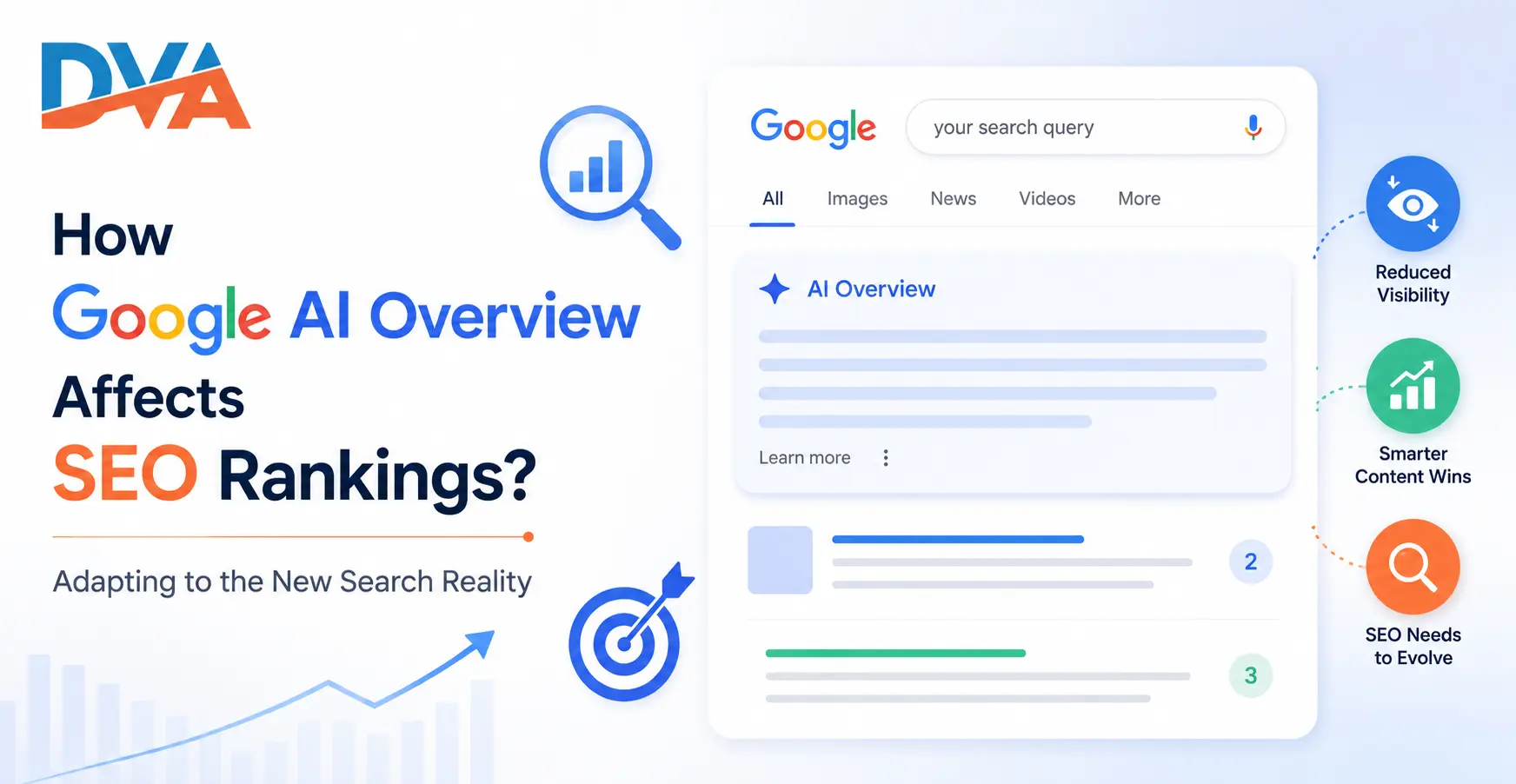
Google’s AI Overview is an AI-generated summary that appears at the very top of Google search results, above all organic links, ads, and featured snippets. It pulls information from multiple websites and synthesizes a direct answer to the user’s query. Users can see the answer, expand it, and optionally click through to source websites listed in a carousel below the summary.
Google uses its Gemini AI model to generate these summaries in real time. The AI does not copy-paste text. It reads and synthesizes information from several top-ranking pages and writes a new, combined answer based on what those pages say. A typical AI Overview cites between 5 and 8 different domains per answer.
This is fundamentally different from anything Google has done before. A 2024 Ahrefs study found that AI Overviews appear in approximately 13% of Google searches in the United States. That percentage is expected to grow as Google expands the feature across more query types and languages, including queries in Tamil and Hindi in India.
How Google AI Overview Works Under the Hood
Google AI Overview is powered by Gemini, Google’s most advanced AI model. When a user types a query, Gemini scans the top-ranking pages, extracts the most relevant passages, and composes a fresh answer. It does not always cite the pages that rank #1 through #10. It selects sources based on clarity, authority, and how directly they answer the query.
This means a page ranked at position 7 can appear in the AI Overview while the #1 ranked page is not cited at all. Content quality and structure matter more than position for getting featured inside the AI Overview. Pages with clear, direct, well-structured answers to specific questions have a significantly higher chance of being cited.
The AI Overview also adapts to the type of question. How-to questions get step-by-step answers. Comparison questions get structured comparisons. Definition questions get concise explanations. Understanding this pattern is the foundation of optimizing your content for Google AI Overview SEO.
How Google AI Overview Affects Your SEO Traffic and Rankings
Does AI Overview Reduce Website Traffic?
Yes, for informational and simple question-based queries. When users get a complete answer directly in the AI Overview, many do not need to click through to any website. This behavior, known as a zero-click search, existed before AI Overviews with featured snippets. AI Overviews make it significantly more common and more thorough.
*The traffic impact is not equal across all content types.* Transactional queries (buy, price, booking, near me) and navigational queries (specific brand or website searches) are far less affected by AI Overviews. If your content targets informational keywords heavily, the traffic drop can be 20% to 40%. If you focus more on commercial intent, the impact is much smaller.
Digital Vishnu Academy
Join 500+ Students Already Building Their Digital Marketing Career
Live projects. AI tools. 100% placement support. Batches in Coimbatore and online.
Which Search Queries Trigger AI Overviews?
AI Overviews most commonly appear for informational queries: “what is,” “how to,” “why does,” “difference between,” and “best way to” style searches. They also appear frequently for definition-type queries, step-by-step process questions, and comparison questions. These are exactly the types of blog posts and educational content that most digital marketing websites produce.
Queries that rarely or never trigger AI Overviews include local service searches (“digital marketing course near me”), brand-specific searches, product purchase queries, news and current events, and highly specific technical queries. Knowing which of your pages target AI Overview-triggering queries is the first step in your adaptation strategy.
Does Being Cited in AI Overview Help Your Brand?
Yes, significantly. While AI Overviews reduce CTR for some queries, being cited as a source inside the AI Overview builds strong brand authority and trust. Users see your domain name listed as a trusted source alongside the AI-generated answer. This increases brand recall, even without a click.
Some marketers report that AI Overview citations actually drive higher-quality traffic — users who do click through after reading the AI summary are already informed about the topic and more ready to take action. The click count may be lower, but the intent quality is often higher. Getting cited in AI Overview is a new ranking signal worth actively pursuing.
AI Overview vs Featured Snippet: Key Differences
Many marketers confuse Google AI Overview with the older Featured Snippet. They serve similar purposes but work very differently. Here is a direct comparison:
| Factor | Google AI Overview | Featured Snippet |
|---|---|---|
| Sources used | Multiple websites (5-8 typically) | Usually one source |
| Page position | Above all organic results | Position 0 (before results) |
| Answer length | 150-400 word synthesized summary | 40-60 word extracted text |
| Content source | Synthesized from many pages | Lifted directly from one page |
| Best query type | How-to, definitions, comparisons | Specific question-answer queries |
| Optimization method | GEO (structured, cited content) | Traditional SEO + snippet markup |
| Launched | May 2024 (US) | 2014 |
How to Optimize Your Content for Google AI Overview in 2026
Optimizing for AI Overview requires a strategy called GEO (Generative Engine Optimization). GEO is the practice of structuring your content so that AI systems like Google Gemini can easily find, understand, and cite it. We cover GEO in depth in our post on what is Generative Engine Optimization and why it matters for SEO.
Here are the 7 most effective steps to get your content cited inside Google’s AI Overview:
- Write direct answer capsules. Place a 30-60 word self-contained answer immediately after each H2 heading. Gemini scans for passage-level answers it can extract and cite directly.
- Use H2 and H3 headings as questions. Frame your subheadings the way a real user would search, for example “How does AI Overview affect click-through rates?” This matches how Gemini identifies relevant answer sections.
- Add FAQ schema markup. Structured data helps Google understand your content as a structured Q and A resource. Mark up your FAQ section with FAQ schema JSON-LD on every informational post.
- Cite authoritative sources. Pages that link to credible external sources (research studies, official data, respected publications) are selected as AI Overview sources more frequently than pages with no external citations.
- Include tables and structured lists. AI Overview frequently reproduces comparison tables and numbered steps from source pages. Well-formatted structured content is easier for AI to extract and re-present accurately.
- Build E-E-A-T signals. Google prioritizes content from authors with demonstrable experience, expertise, authority, and trustworthiness. Add author bios, credentials, first-person experience, and real examples to every important post.
- Update content regularly. Google AI Overview tends to favor recently updated, accurate content. Refresh your most important informational pages every 6 to 12 months with current data and updated examples.
Should You Change Your Entire SEO Strategy Because of AI Overview?
No, but you should add a new layer to it. Traditional SEO, which focuses on rankings, keywords, backlinks, and technical optimization, is still the foundation. AI Overview does not replace organic rankings. It sits above them. You still need to rank well organically to even be considered as a source for AI Overview citations.
What you need to add is the GEO layer: structuring your content with direct answer capsules, question-based headings, FAQ markup, and cited sources. Think of it as writing for two audiences simultaneously: human readers who browse your page and AI systems that scan your content for citable passages. The on-page SEO fundamentals you already follow are still 100% relevant. GEO adds to them, it does not replace them.
The digital marketers who adapt early to this shift will have a significant advantage. If you want to build these skills with structured training and real-world practice, the digital marketing course in Coimbatore at Digital Vishnu Academy now covers both traditional SEO and GEO optimization as part of its curriculum.
Watch: SEO Fundamentals You Need Before Optimizing for AI Overview
Before you optimize for AI Overview, make sure your core SEO foundations are solid. This tutorial from Digital Vishnu Academy covers the SEO basics every marketer needs in 2026:
Related Posts You Should Read
Conclusion
Google’s AI Overview is changing how SEO rankings translate into website traffic. Ranking on page one is no longer enough on its own. To win in 2026, your content needs to both rank organically and be structured well enough to be cited inside the AI Overview box itself.
The good news is that the fundamentals have not changed. High-quality, well-structured, authoritative content still wins. GEO just adds a new layer of intentional structure: direct answer blocks, question-based headings, FAQ markup, and external citations. Marketers who add this layer to their existing SEO strategy now will have a clear head start as AI Overviews become the dominant feature of Google search.
Start building the SEO and GEO skills that matter most right now. Visit Digital Vishnu Academy to learn how our practical training programs in Coimbatore prepare digital marketers for a search landscape where both rankings and AI citations determine your visibility online.
Frequently Asked Questions
What is Google’s AI Overview in SEO?
Google’s AI Overview is an AI-generated summary that appears at the top of search results, above all organic rankings. It uses Google’s Gemini AI to synthesize answers from multiple websites. For SEO, it means users may get the answer they need without clicking any website link, reducing click-through rates for informational queries while increasing brand visibility for sites that are cited.
Does Google AI Overview hurt SEO rankings?
AI Overview does not directly affect your organic ranking position. Your pages can still rank in the same positions they did before. What changes is the click-through rate: users who get a complete answer from the AI summary are less likely to click through to your site. The traffic impact is most significant for simple informational queries and much less so for commercial, transactional, or local intent queries.
How do I get my website featured in Google AI Overview?
To get cited in Google AI Overview, structure your content with direct 30-60 word answer capsules after each heading, use question-style H2 and H3 headings, add FAQ schema markup, cite authoritative external sources, and build strong E-E-A-T signals. Clear, direct, well-organized content that answers specific questions is far more likely to be selected by Gemini as a citation source.
What is the difference between AI Overview and Featured Snippet?
Featured Snippets extract a short answer from one specific website and display it above organic results. AI Overview synthesizes a longer, comprehensive answer from multiple websites (typically 5-8 sources) and appears even higher on the page. Featured Snippets drive clicks to one source. AI Overview distributes visibility across several sources while potentially reducing clicks to all of them for simple queries.
Should I change my SEO strategy because of Google AI Overview?
You should add to your SEO strategy, not replace it. Traditional on-page SEO, backlink building, and technical optimization remain the foundation for ranking. On top of that, add GEO optimization: structured answer capsules, question-based headings, FAQ markup, and authoritative citations. Both layers working together give you the best chance of ranking in organic results and being cited in the AI Overview simultaneously.