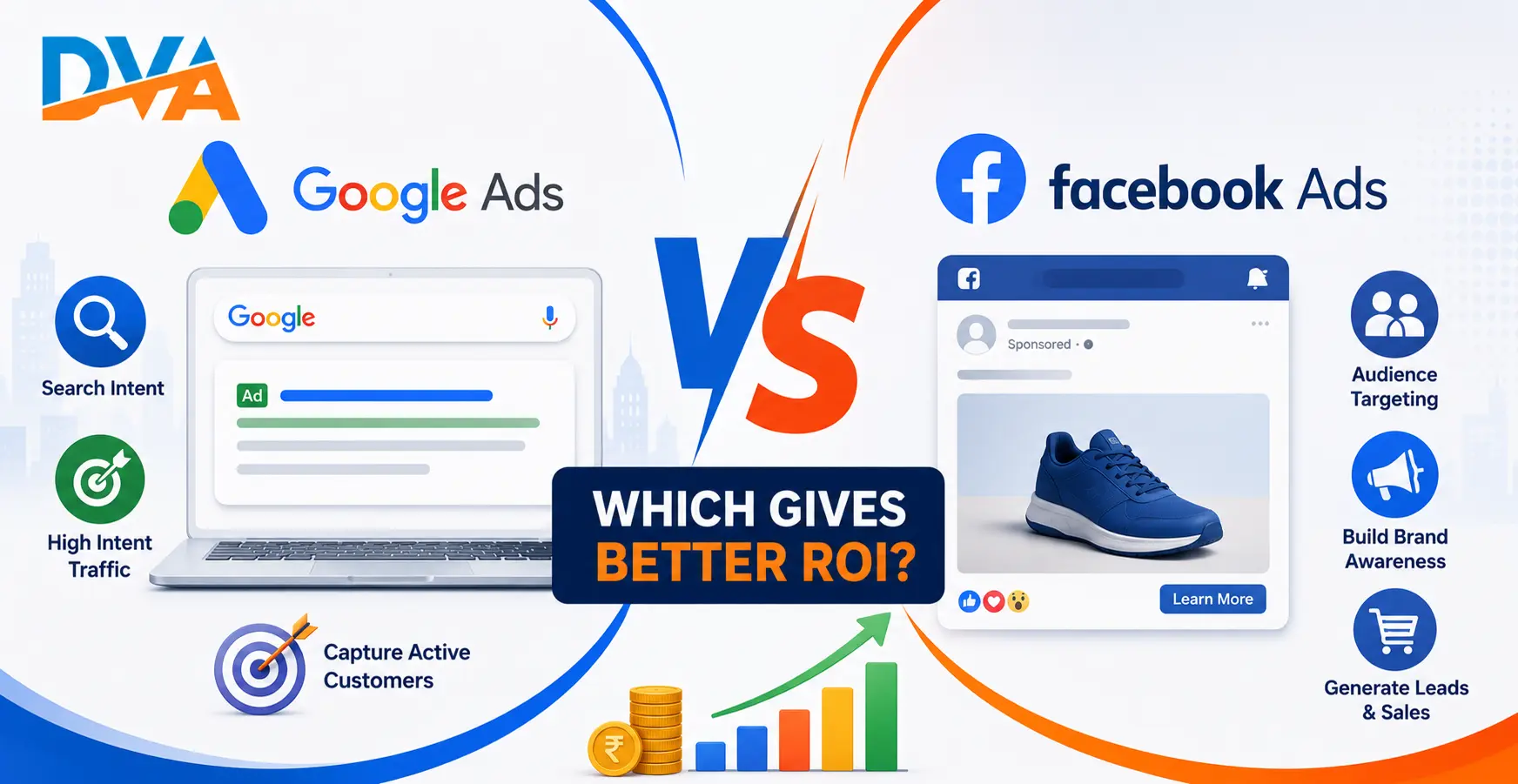
Neither platform always gives better ROI — it depends on what you are selling, who your customers are, and what stage of awareness they are in. Google Ads works best when people are actively searching for what you offer. Facebook Ads works best for reaching people who do not yet know they need your product. Many businesses get the strongest results using both platforms together for different stages of the buying journey.
The real question is not “which platform is better?” — it is “which platform matches my customer’s behaviour right now?” Google Ads captures people already looking for a solution. Facebook Ads introduces your offer to people who are not yet looking. If your business has an immediate-need or search-driven service, start with Google Ads. If you sell something that benefits from visual discovery or specific demographic targeting, Facebook Ads often wins on cost per lead.
Most businesses that try paid advertising eventually ask the same question: should they put their budget into Google Ads or Facebook Ads? Both platforms have hundreds of millions of daily active users. Both can drive real business results. And both can waste your budget quickly if set up wrong.
This guide explains how each platform actually works, when each gives better return on investment, and how to choose the right starting point for your specific business situation.
How Google Ads and Facebook Ads Actually Work
Google Ads works on search intent. When someone types “dentist near me” or “digital marketing course in Coimbatore” into Google, they already want a solution. They are ready to take action. Your ad appears at exactly this moment of intent. You pay when they click. Google Ads is built to connect businesses with people at the moment of active need.
Facebook Ads (part of Meta Ads, covering both Facebook and Instagram) works on interest targeting. You define the audience you want to reach — by age, location, job title, interests, or past behaviour — and Meta shows your ad to those people in their newsfeed or stories. They were not searching for you. Your ad interrupts their scrolling and tries to earn their attention.
This fundamental difference — intent-based targeting vs. interest-based targeting — is the starting point for every ROI comparison between the two platforms. It explains why the same budget can perform very differently depending on the business, the audience, and the goal.
Google Ads vs Facebook Ads — Key Differences at a Glance
| Factor | Google Ads | Facebook / Meta Ads |
|---|---|---|
| How users are targeted | By keyword search intent | By demographics, interests, behaviour |
| User mindset | Actively looking for a solution | Browsing, not specifically searching |
| Best ad format | Text ads, Shopping, Display | Image, video, carousel, stories |
| Best for | Services, urgent needs, B2B, local search | Visual products, brand building, discovery |
| Purchase intent | High — searching = ready to act | Variable — needs creative to convert |
| Remarketing | Google Display Network | Facebook + Instagram retargeting |
| ROI speed | Faster for high-intent service categories | Faster for impulse and visual purchases |
| Minimum spend | No minimum required | No minimum required |
Actual cost per click and cost per lead vary significantly by industry, location, competition level, and campaign quality. No universal cost figure applies to either platform.
When Google Ads Typically Gives Better ROI
Services with high search intent:
Coaching centres, clinics, lawyers, repair services, and training institutes get consistently strong Google Ads results because people search for them by category. Someone searching “digital marketing course Coimbatore” is already looking for exactly what a training centre offers. A well-matched Search ad captures that intent at the exact right moment. For a breakdown of how SEO and Google Ads compare for this type of business, our guide on SEO vs Google Ads — which is better for your business covers the practical decision.
Emergency or immediate-need services:
Plumbers, electricians, locksmiths, towing services, and similar businesses see some of the strongest Google Ads ROI in any category. When something breaks, people search immediately. They need a solution now. A phone call from a Google Ads click converts at a very different rate from a Facebook impression seen three weeks before the problem occurred.
B2B services with specific search terms:
Business buyers use Google with specific, professional search queries. “Accounting software for SMEs,” “logistics provider Tamil Nadu,” or “SEO agency Coimbatore” are searches with clear commercial intent. Google Ads can intercept these at exactly the moment a decision is being researched.
Local service businesses:
Google Ads with location targeting lets local businesses appear for “[service] near me” and “[service] in [city]” searches. Combined with a well-set-up Google Business Profile, this gives local service businesses visibility at the highest-intent moment in the customer journey.
When Facebook Ads Typically Gives Better ROI
Visual products and lifestyle categories:
Fashion, food, beauty, home decor, fitness, and similar categories perform strongly on Facebook and Instagram because these platforms are image and video-first environments. The ad format — a photo or video appearing in a newsfeed — suits products that are better shown than described in a text headline.
Ready to start?
Learn Digital Marketing with Live Projects at Digital Vishnu Academy, Coimbatore
SEO, Google Ads, Social Media, AI Tools and more. Job-ready in 3 months.
Discovery and impulse purchases:
If your product is something people do not actively search for but would buy if they saw it in the right context, Facebook Ads can be highly effective. New product launches, subscription offerings, novelty gifts, and experience-based services suit the Facebook discovery environment well. The product introduces itself through the ad rather than responding to a search.
Specific demographic targeting:
Facebook’s targeting allows you to reach very defined audiences: working women aged 28–40 in Coimbatore interested in online learning, or small business owners in Tamil Nadu who follow digital marketing pages. This level of demographic and interest precision is not achievable through Google Search campaigns, which target what people type, not who they are.
Retargeting warm audiences:
People who visited your website but did not convert are a high-value, high-intent audience for Facebook retargeting. Showing specific ads to these people as they browse Facebook and Instagram often delivers a significantly lower cost per conversion than cold traffic campaigns on either platform. For small businesses managing limited advertising budgets, retargeting campaigns often deliver the best ROI of any paid ad activity. Our guide to digital marketing for small businesses in Coimbatore covers when paid advertising makes sense and how to start small.
How to Decide Which Platform Is Right for Your Business
Choose Google Ads first if:
- Your product or service has specific search terms people use to find it
- Customers typically find businesses like yours through Google search
- You offer an emergency, urgent, or time-sensitive service
- Your target customer is a business buyer using professional search terms
- You want the most direct path from ad click to enquiry or sale
Choose Facebook Ads first if:
- Your product benefits from visual presentation — photos or video sell it better than text
- Your target customer is better defined by who they are than what they search for
- You are launching something new that people do not yet know to search for
- Your goal is to build brand recognition with a specific demographic over time
- You want to retarget website visitors who did not convert on their first visit
If you are unsure which category your business falls into, look at where your existing customers came from. If most found you through a Google search, your customers are search-driven and Google Ads is the right starting point. If most found you through social media, a referral, or an Instagram post, your customers are influence-driven and Facebook Ads will likely match your audience better.
Can You Use Both Google Ads and Facebook Ads Together?
A practical combined approach works like this:
- Google Ads captures active demand. Someone searches for your service, clicks your ad, visits your landing page, and either converts immediately or leaves without taking action.
- Facebook retargeting re-engages website visitors. Show those same visitors a Facebook or Instagram ad with a specific message — a reminder, a testimonial, a special offer, or a direct call to action. This recovers conversions you would otherwise lose.
- Facebook Ads builds awareness for future search. People see your brand on social media. Weeks later, when they have a need, they search your name on Google — and that is often where they convert. The Facebook ad planted the seed; the Google search was the harvest.
This full-funnel approach uses Google Ads for high-intent conversion and Facebook Ads for awareness and retargeting. For beginners ready to set up their first paid campaign, our step-by-step guide to running your first Google Ads campaign covers the setup process from account creation to going live.
Common Mistakes That Kill ROI on Both Platforms
Mistakes on Google Ads:
- No conversion tracking — you cannot know which keywords are producing results
- Keywords too broad or match types too loose — budget spent on irrelevant searches
- Ad links to homepage instead of a specific offer-matched landing page
- No negative keyword list — ads show for searches that will never convert
- Pausing campaigns in the first week before sufficient data is collected
Mistakes on Facebook Ads:
- Audience too broad or too narrow — reach without relevance, or relevance without scale
- Weak visual creative — the ad does not stop the scroll, so the message is never seen
- No clear call to action — viewer is interested but does not know what to do
- Wrong campaign objective — using Brand Awareness when the goal is Lead Generation
- No retargeting campaign — losing warm visitors who almost converted
The mistake common to both platforms: expecting fast results from a new campaign with too small a budget and too short a timeline. Both Google Ads and Facebook Ads have learning phases where the algorithm collects data before optimising delivery. Running a campaign for less than two to four weeks with limited spend rarely produces reliable conclusions about what works.
Google Ads vs Facebook Ads is not a question with a single correct answer. The right platform depends on your customer’s buying behaviour, your product type, and your marketing goal at this stage of your business. Google Ads and Facebook Ads are not competitors for your budget — they are tools for different jobs. Choosing the right tool for the right job is what produces ROI. Choosing based on which platform someone else said is “better” rarely works.
Set up conversion tracking on whichever platform you start with. Measure cost per lead or cost per sale, not just clicks or impressions. Run the campaign long enough to collect real data. Then scale what works.
If you want to learn how to run effective paid advertising campaigns — including live Google Ads and Facebook Ads setup with real budgets and real projects — our digital marketing course in Coimbatore covers both platforms in full alongside SEO, content marketing, and social media.
Frequently Asked Questions
Which is cheaper — Google Ads or Facebook Ads?
The cost per click on Facebook Ads is often lower than on Google Search Ads. However, lower cost per click does not automatically mean better ROI. A higher-cost Google click from someone actively searching for your service may convert into a paying customer far more reliably than multiple cheap Facebook clicks from people who were just browsing. Compare cost per lead or cost per sale, not cost per click, when evaluating either platform.
Which gives faster results — Google Ads or Facebook Ads?
For high-intent service businesses, Google Search Ads can generate enquiries within hours because the audience is already looking for what you offer. Facebook Ads typically takes longer to convert cold audiences because it must first earn attention from people who were not searching. However, Facebook retargeting campaigns targeting warm website visitors can produce results quickly. The timeline depends heavily on the product type, offer quality, and audience.
Which paid advertising platform is better for local businesses in India?
For local service businesses in India — clinics, training centres, repair services, consultants — Google Search Ads often deliver strong ROI because local customers search Google to find nearby services. Facebook Ads works well for local businesses with visual products, community engagement goals, or audiences who need to discover the product rather than search for it. Many successful local businesses use both platforms for different campaign objectives.
Can I start Google Ads or Facebook Ads with a small budget?
Yes. Both platforms have no minimum spend requirement. However, a very small daily budget may not generate enough clicks or conversions to give you meaningful data within a reasonable timeframe. As a guideline, budget enough to get at least 50–100 clicks per week on the keywords or audiences you are targeting. This gives you enough data to make informed decisions about what to continue, change, or stop.
Does Facebook Ads work for B2B businesses?
Facebook Ads can work for B2B, but it typically performs better for consumer-facing products and services. LinkedIn Ads are often more effective for B2B campaigns because professionals use LinkedIn with a business mindset. For B2B businesses, Google Ads targeting professional search terms often delivers stronger purchase intent than Facebook’s social browsing environment. Test both if your audience is present on both platforms.
What should I measure to compare ROI between Google Ads and Facebook Ads?
Measure cost per lead, cost per sale, and total revenue generated relative to total ad spend. Clicks and impressions measure activity but not business outcomes. Set up conversion tracking on both platforms before campaigns go live. Once you have at least two to four weeks of data from each platform, compare cost per actual business result — not cost per click — to make a fair ROI comparison.
Sources and Further Reading
- Google Ads — Official Google advertising platform covering Search, Display, Shopping, and YouTube campaigns
- Meta Ads (Facebook Ads) — Official Meta advertising platform covering Facebook, Instagram, Messenger, and Audience Network