
TL;DR: Yes, you can absolutely learn digital marketing without a degree. Most digital marketing job postings in India don’t require a specific degree — they ask for skills, certifications, and a portfolio of real work. A structured training programme, hands-on project experience, and Google or Meta certifications carry far more weight with hiring managers than a college qualification in an unrelated subject.
You finished your degree in commerce, or science, or maybe you didn’t finish at all. And now you’re looking at digital marketing as a career and wondering: does my educational background disqualify me?
It doesn’t. Not even close.
Digital marketing is one of the few high-demand careers in India where your skill set, your portfolio, and your certifications matter far more than the letters after your name. This post explains why, what employers actually want, and exactly how to get from where you are now to a working digital marketing career without a degree.
Can I Learn Digital Marketing Without a Degree?
Yes, you can learn digital marketing without a degree, and thousands of working digital marketers in India today did exactly that. Digital marketing is a skills-based field. The tools, platforms, and strategies you need to learn are taught in structured training programmes, not university lecture halls. What gets you hired is proof that you can run campaigns, optimise content, and deliver results — not a certificate from an affiliated college.
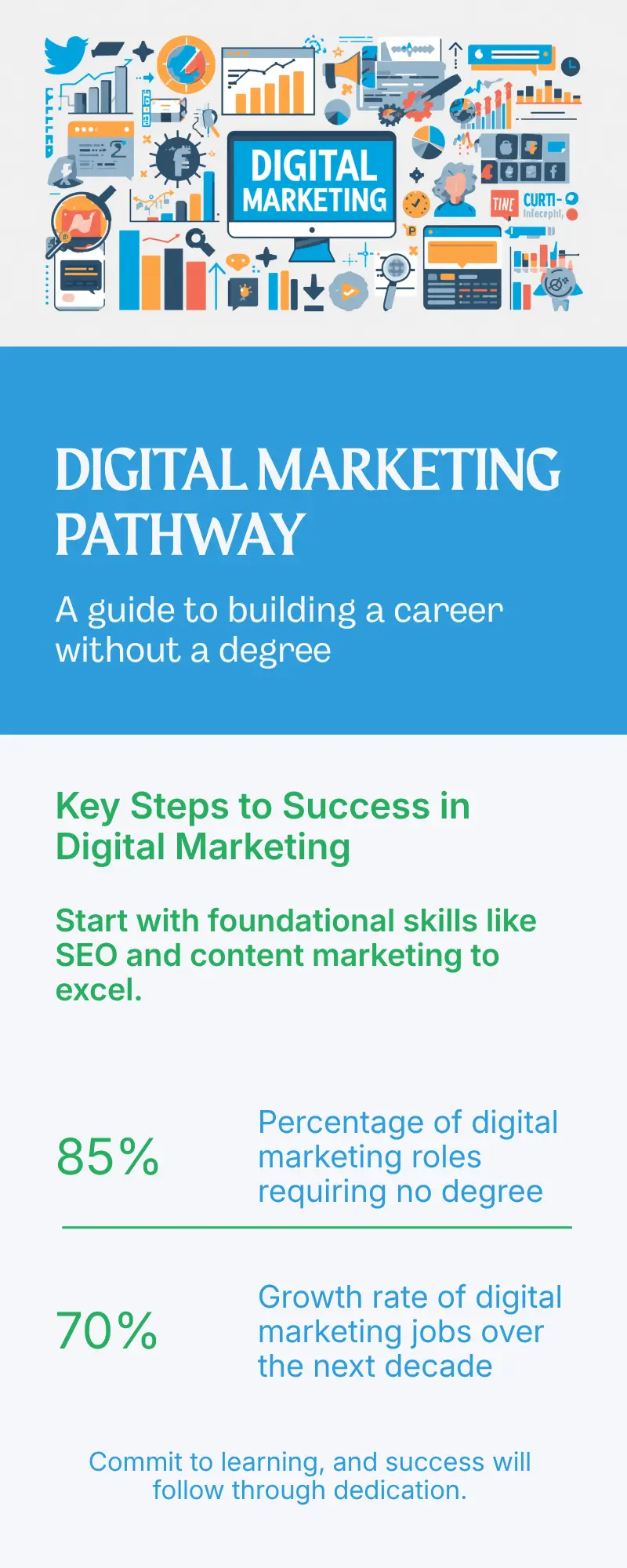
Over 82% of digital marketing job postings on LinkedIn do not require a specific degree field. Most list skills like SEO, Google Ads, Meta Ads, content creation, and analytics as requirements. A fresher who has completed a structured digital marketing course and built a real portfolio is a stronger candidate than a marketing graduate with no practical experience.
Do Employers Require a Degree for Digital Marketing Jobs in India?
Most don’t. The digital marketing industry in India has a skills gap, not a degree gap. India’s digital advertising market is growing at over 25% annually, and companies are hiring faster than universities can produce relevant graduates. This creates real hiring pressure for agencies and in-house teams to look beyond degree requirements.
What employers actually screen for in job postings and interviews:
- Can you run a Google Ads campaign from setup to optimisation?
- Do you understand keyword research and on-page SEO?
- Can you interpret GA4 data and explain what it means for campaign decisions?
- Do you have Google Skillshop or Meta Blueprint certifications?
- Do you have a portfolio showing real results from real campaigns?
None of those questions have anything to do with your degree. A B.Com graduate who has done a digital marketing course and run live campaigns answers yes to all of them. A marketing MBA who has only studied theory answers yes to none of them. Employers know the difference.
What Employers Actually Look for Instead of a Degree
If a degree isn’t the deciding factor, what is? Here’s what hiring managers at digital marketing agencies and in-house marketing teams consistently prioritise when screening entry-level candidates:
| What Employers Look For | Why It Matters | How to Get It Without a Degree |
|---|---|---|
| Google Ads certification | Proves platform knowledge for the tools they use daily | Free via Google Skillshop, takes 4–8 hours each |
| GA4 / Analytics proficiency | Every campaign needs someone who can read data | Covered in structured digital marketing courses |
| Portfolio with real campaigns | Proof you can execute, not just recite theory | Built during live project work in an institute programme |
| SEO knowledge | Organic traffic is the highest-ROI channel for most businesses | Taught as a core module in all quality digital marketing courses |
| Meta Ads experience | Facebook and Instagram are core channels for most clients | Hands-on training + Meta Blueprint certification (free) |
| Content creation ability | Every brand needs someone who can write and plan content | Practice during training and through personal projects |
| Communication and reporting | Marketers present results to clients and managers | Developed during mock interviews and project presentations |
Every single item on that list is something you can build through a structured course and live project experience. No degree required for any of it.
What Skills Do You Need to Learn Digital Marketing Without a Degree?
Learning digital marketing without a degree means replacing the credential with a clear skill stack. Here are the core skills that make a fresher hireable in 2026, regardless of educational background:
Search Engine Optimisation (SEO)
Keyword research, on-page SEO, technical audits, and link building basics. SEO is the foundation of organic traffic and one of the highest-demand skills across agencies, e-commerce brands, and content businesses.
Google Ads (Search and Display)
Campaign creation, keyword targeting, bid strategy, and performance optimisation. Over 70% of digital ad campaigns in India run on Google’s platforms, so Google Ads proficiency is non-negotiable for most roles.
Meta Ads (Facebook and Instagram)
Audience building, creative testing, retargeting, and campaign analytics. Meta Ads is the primary paid channel for most D2C brands and local businesses.
Content Marketing
Blog writing, content calendars, SEO-driven topic research, and performance measurement. Every business needs content, and someone who can produce it strategically is always in demand.
Email Marketing
List building, automation sequences, A/B testing, and deliverability basics. Email consistently delivers the highest ROI of any digital channel, making it a skill employers value in every market.
Analytics (GA4)
Setting up tracking, reading traffic reports, understanding conversion data, and presenting insights clearly. Data literacy is what separates junior marketers who stagnate from those who get promoted.
100% Placement Support
Get Placed After Your Digital Marketing Course at DVA Coimbatore
Resume building, interview prep, and direct company tie-ups. Real placements, not promises.
AI Tools for Marketing
Using ChatGPT, Gemini, and Canva AI for content creation, ad copy generation, and creative production. Candidates with AI tool proficiency command a 15–20% salary premium in 2026 compared to those without it.
For a full breakdown of what each of these modules covers in a structured programme, read the complete digital marketing course syllabus.
Degree vs No Degree in Digital Marketing — How Do You Actually Compare?
Let’s put this side by side, honestly. Here’s how a degree holder compares to a non-degree candidate who has completed a structured digital marketing course:
| Factor | Degree Holder (No Marketing Course) | No Degree + Digital Marketing Course |
|---|---|---|
| Platform knowledge (Google Ads, Meta) | Usually none | Trained and certified |
| SEO skills | Usually none | Covered in core modules |
| Live project experience | Rarely included in degree programmes | Built during training on real accounts |
| Portfolio | None (unless built independently) | 2–3 projects ready at graduation |
| Certifications | None (unless earned separately) | Google + Meta + HubSpot included |
| Placement support | General college placement only | Digital marketing-specific placement support |
| Interview readiness | Low (theory-heavy, tools-light) | High (mock interviews, resume prep) |
| Time to first job | 3–4 years (degree) + job search | 3–6 months (course) + placement support |
The non-degree candidate who completes a quality digital marketing course is often more job-ready on day one than the degree holder without practical training. That’s not an argument against degrees in general. It’s a recognition that in digital marketing specifically, practical skills beat theoretical education when hiring decisions get made.
How Long Does It Take to Learn Digital Marketing Without a Degree?
This depends on your learning path, but the timelines are far shorter than any degree programme. Here’s what realistic learning timelines look like for someone starting from scratch:
Structured institute course (recommended): 3–4 months to cover all core channels, earn certifications, build a portfolio, and complete placement preparation. This is the fastest path to employment because it combines learning, project work, and job support into one programme. Read more on the is 3 months enough to learn digital marketing breakdown for a detailed timeline.
Self-study (free courses + independent projects): 6–12 months to cover the same material, build a portfolio, and earn certifications — if you stay consistent. The challenge is that self-paced courses have a completion rate of just 5–15%. Most people who plan to self-study digital marketing in their spare time take significantly longer than 6 months, or don’t finish at all.
Part-time while working: 6–8 months if you can commit 1–2 hours per day consistently. Possible but requires significant discipline and a clear study plan.
For most people without a degree who want to get into digital marketing as quickly as possible, a 3–4 month structured institute course is the most reliable path. See the full comparison of learning options in the free vs paid digital marketing course guide.
Step-by-Step Path to a Digital Marketing Job Without a Degree
Here’s the exact roadmap to follow if you’re starting from no degree and no digital marketing experience:
Step 1: Choose a structured digital marketing course (Month 1)
Join a quality institute programme that covers all core channels with live project access. Look specifically for programmes that include Google Skillshop and Meta Blueprint certification preparation, real client project work, and placement support. A generic online course or YouTube playlist won’t give you all three.
At Digital Vishnu Academy, a recognised digital marketing course institute in Coimbatore, the programme is built for exactly this profile: beginners with no marketing background who want to build a career-ready skill set in 3–4 months.
Step 2: Earn your Google and Meta certifications (Month 2–3)
Google Skillshop certifications (Google Ads Search, Google Ads Display, GA4) are free and take 4–8 hours each. Meta Blueprint certification is also free. Earn these during your training while the content is fresh. They go directly on your LinkedIn profile and resume, and they signal platform competence to recruiters immediately.
Step 3: Build a portfolio with 2–3 real projects (Month 3–4)
Document every live project you work on during training. Include campaign screenshots, traffic data, SEO audit reports, and before/after comparisons where possible. Two to three documented projects with real numbers are worth more to a hiring manager than any certificate or degree.
Step 4: Optimise your LinkedIn profile (Month 3–4)
A complete LinkedIn profile with a clear headline (“Digital Marketing Executive | SEO | Google Ads | Meta Ads”), all certifications listed, and portfolio project links gets you found by recruiters without you applying to a single job posting. Many freshers who get their first digital marketing job are found this way.
Step 5: Use placement support and apply early (Month 4)
Don’t wait until you feel “ready.” Apply during your final two weeks of training. Use the resume review and mock interview support your institute provides. The interview experience itself will sharpen your confidence, and you might receive an offer before you graduate.
Entry-level digital marketing roles in India in 2026 pay between ₹3.5 LPA and ₹6.5 LPA for freshers, with candidates who hold Google certifications and AI tool experience consistently landing at the upper end. That salary is achievable without a single university degree if you follow this path.
Explore the digital marketing course in Coimbatore at DVA to see exactly how the programme is structured for beginners without a marketing background.
Your Background Is Not the Barrier You Think It Is
Can you learn digital marketing without a degree? Yes. The proof is the thousands of working digital marketers in India today who built their careers on skills, not certificates from a university.
Digital marketing rewards what you can do, not what you studied. A portfolio showing real Google Ads campaigns, SEO improvements, and analytics reports speaks louder than any degree. And that portfolio is something you can build in 3–4 months through structured training, regardless of your educational background.
Your next step is simple. Choose a programme with live projects and placement support. Commit to 3–4 months. Build the skills, earn the certifications, document the work. That’s the path. It’s open to you right now.
Frequently Asked Questions
Can I get a digital marketing job in India without a degree?
Yes. Most digital marketing job postings in India do not require a specific degree. Employers prioritise skills, certifications, and portfolio work. A fresher who has completed a structured digital marketing training programme with live project experience and holds Google and Meta certifications is competitive for entry-level roles regardless of their educational qualification. The digital marketing industry in India has a skills shortage, and companies hire based on what you can do.
Which digital marketing skills are most important to learn without a degree?
The highest-priority skills to learn are SEO, Google Ads (Search and Display), Meta Ads, Google Analytics 4 (GA4), content marketing, and email marketing. Add AI tool proficiency (ChatGPT, Gemini, Canva AI) to command a salary premium in 2026. These six skill areas cover what the majority of entry-level digital marketing roles require, and all of them are taught in a quality 3–4 month structured course.
Do I need a marketing degree to learn digital marketing?
No. A marketing degree is not a prerequisite for learning or working in digital marketing. The tools, platforms, and strategies used in digital marketing are learned through hands-on training and real campaign experience, not through university coursework. Many successful digital marketers in India come from engineering, commerce, arts, and science backgrounds with no formal marketing education.
Is a digital marketing certificate enough to get a job without a degree?
A certificate alone is rarely enough. What gets you hired is the combination of a recognised certificate, a portfolio of real work, and platform certifications from Google or Meta. A certificate from a quality institute signals that you completed structured training. Your portfolio proves you can apply what you learned. Google and Meta certifications validate platform-specific knowledge. Together, these three elements replace the degree in the eyes of most hiring managers.
How much can I earn in digital marketing without a degree in India?
Entry-level digital marketing roles in India in 2026 pay between ₹3.5 LPA and ₹6.5 LPA for freshers, regardless of educational background. Candidates with Google and Meta certifications, AI tool proficiency, and a strong portfolio land at the upper end of this range. With 2–3 years of experience, salaries rise to ₹6 LPA to ₹12 LPA depending on specialisation and the type of company.