
TL;DR: Yes, 3 months is enough to become job-ready in digital marketing, but only if you follow a structured programme with live project work. In 3 months you can learn SEO, Google Ads, Meta Ads, content marketing, email marketing, and GA4 analytics at a level where you can handle entry-level roles. Self-study in 3 months is much harder. A structured course makes the difference between finishing with a portfolio and finishing with nothing to show.
Three months. Ninety days. Can you go from zero knowledge to a digital marketing career in that time?
It’s one of the most common questions from students and career switchers in India. And it’s a fair one, because the answer has real financial stakes. If 3 months is enough, you can plan your career switch or your first job search around a clear timeline. If it isn’t, you need to know what’s realistic before you invest time and money.
This post gives you the straight answer, a week-by-week learning plan, and the honest truth about what 3 months of training will and won’t get you.
Is 3 Months Enough to Learn Digital Marketing?
Yes, 3 months is enough to become job-ready in digital marketing, but what you can do with those 3 months depends entirely on how you spend them. Three months of structured, hands-on training through a quality programme produces a candidate who can handle entry-level digital marketing roles. Three months of random YouTube videos and free courses usually doesn’t.
The distinction matters. Self-paced online courses have a completion rate of just 5–15%, while structured programmes run by institutes see 60–72% of students complete their training and build a portfolio. It’s not willpower that makes the difference. It’s the structure, the accountability, and the live project access that a quality institute provides.
If you’re asking “is 3 months enough to learn digital marketing well enough to get hired,” the answer is yes, with the right programme. If you’re asking whether 3 months is enough to become an expert who can run complex enterprise campaigns, the answer is no, and nobody should promise you that either.
What Can You Realistically Learn in 3 Months of Digital Marketing?
Three months is more than enough time to learn every core channel of digital marketing at a working level. Here’s what a well-designed 3-month digital marketing course covers, and what competency you reach by the end:
| Channel / Skill | What You’ll Be Able to Do After 3 Months | Job Readiness Level |
|---|---|---|
| Search Engine Optimisation (SEO) | Keyword research, on-page SEO, basic link building, technical SEO audits | Entry-level ready |
| Google Ads (Search & Display) | Campaign setup, keyword targeting, ad copywriting, bid management | Entry-level ready |
| Meta Ads (Facebook & Instagram) | Audience targeting, campaign creation, A/B testing, retargeting basics | Entry-level ready |
| Content Marketing | Blog content planning, SEO writing, content calendars | Entry-level ready |
| Social Media Marketing | Profile setup, organic content strategy, scheduling, engagement | Entry-level ready |
| Email Marketing | List building, automation basics, campaign creation with tools like Mailchimp | Entry-level ready |
| Google Analytics 4 (GA4) | Traffic analysis, goal tracking, basic reporting | Working knowledge |
| WordPress / Website Basics | Page setup, landing page creation, basic CMS management | Working knowledge |
| AI Tools for Marketing | Using ChatGPT, Gemini, and Canva AI for content and creative work | Foundational proficiency |
That’s a complete foundation. Hiring managers at digital marketing agencies and in-house teams actively recruit freshers with exactly this skill set. The role titles you’re qualified for after 3 months include Digital Marketing Executive, SEO Executive, Social Media Executive, PPC Executive, and Content Executive.
What a 3-Month Digital Marketing Learning Plan Looks Like Week by Week
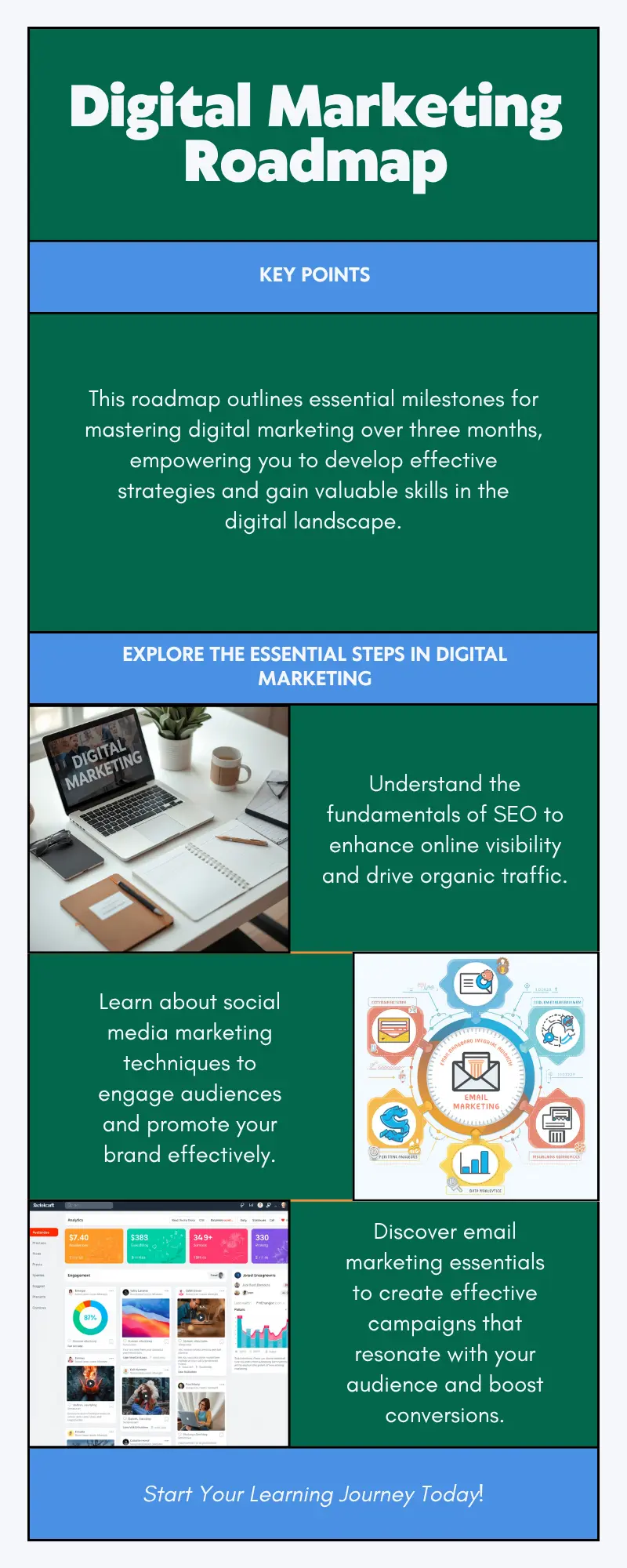
Here’s how a structured 3-month digital marketing course breaks down week by week, so you know exactly what to expect at each stage:
| Month | Weeks | Focus Area | Key Outcome |
|---|---|---|---|
| Month 1 | Week 1–2 | Digital marketing overview, website basics, WordPress setup, content marketing fundamentals | Understand how all channels connect; set up a basic website |
| Month 1 | Week 3–4 | SEO: keyword research, on-page optimisation, technical SEO, Google Search Console | Conduct your first keyword audit and fix on-page SEO issues |
| Month 2 | Week 5–6 | Google Ads: Search campaigns, Display campaigns, Shopping campaigns, Google Skillshop certification prep | Run a live Google Ads campaign with a real (or mock) budget |
| Month 2 | Week 7–8 | Social media marketing, Meta Ads: audience building, creative strategy, A/B testing, retargeting | Launch a Meta Ads campaign; build and analyse an audience |
| Month 3 | Week 9–10 | Email marketing, YouTube marketing, GA4 analytics, conversion tracking | Set up GA4 goals; create an email sequence from scratch |
| Month 3 | Week 11–12 | Live project work, portfolio building, resume prep, mock interviews, Google and Meta certifications | Complete 2–3 portfolio projects; earn certifications; prepare for job interviews |
That’s a packed but achievable 12-week schedule. Notice that the final two weeks aren’t about learning new content. They’re about applying everything you’ve learned on real projects and preparing to prove it in interviews. That’s the piece most self-study learners skip, and it’s why they struggle to get hired even after completing a course.
3 Months of Self-Study vs 3 Months in a Structured Course — What’s the Difference?
If 3 months is the timeline either way, why does it matter whether you self-study or join a course? The difference in outcomes is significant, and it comes down to four factors:
1. Live project access
Self-study gives you knowledge. A structured course gives you knowledge plus real campaign experience. Running an actual campaign on a client account or a live website produces results you can show in an interview. Watching tutorials doesn’t.
2. Completion
As noted, self-paced learners complete their courses at a rate of just 5–15%. Structured courses run at 60–72%. Most people who start a free YouTube playlist to “learn digital marketing in 3 months” are not watching episode 47 three months later. Most people who pay for and commit to a classroom or live-online course are.
3. Doubt clearing
Digital marketing tools change frequently. Google updates its Ads interface. Meta changes targeting options. GA4 replaced Universal Analytics. When something changes or something doesn’t work the way a tutorial said it would, a mentor answers your question immediately. When self-studying, you spend hours searching for the answer yourself.
4. Placement support
This is the biggest practical difference. A good institute helps you with your resume, prepares you for interviews, and refers you to hiring companies. Free courses don’t do any of this. Completing a free course and job-ready are not the same thing.
For a full breakdown of this comparison, read the free vs paid digital marketing course analysis on this site.
What You Won’t Master in 3 Months (And That’s Fine)
Honesty matters here. Three months builds a job-ready foundation. It doesn’t make you an expert in everything. Here’s what takes longer to develop, and why that shouldn’t stop you from starting your career after 3 months:
Ready to start?
Learn Digital Marketing with Live Projects at Digital Vishnu Academy, Coimbatore
SEO, Google Ads, Social Media, AI Tools and more. Job-ready in 3 months.
Advanced campaign strategy
Optimising a large-budget Google Ads account or running complex multi-channel attribution models takes real campaign experience over time. You learn the mechanics in 3 months. The strategy improves with every campaign you run on the job.
Deep SEO authority building
Link building at scale and building topical authority for competitive keywords takes months of consistent effort. You’ll understand how it works and be able to do it. Seeing significant results in a brand-new domain takes 6–12 months of ongoing work after your training.
Advanced analytics and attribution
GA4, BigQuery, Looker Studio, and multi-touch attribution are skills that develop over years of working with data. In 3 months you’ll be proficient enough to report on traffic, set up goals, and understand what the numbers mean. Advanced data analysis comes with experience.
Industry-specific strategy
Marketing a B2B SaaS product is different from marketing a local restaurant. These nuances come with real work experience. Your training gives you the transferable skills. The industry-specific knowledge comes on the job.
The point is this: you don’t need to master everything before you start working. You need to know enough to add value on day one, and continue learning on the job. Every working digital marketer is still learning. Your 3-month training gets you to the starting line, not the finish line.
Can You Get a Job After 3 Months of Digital Marketing Training?
Yes, and many students do exactly that. But the jobs go to students who finish with a portfolio, not just a certificate. Here’s what separates candidates who get hired in 3 months from those who don’t:
Portfolio with real results
Two to three documented projects showing actual campaign metrics, ranking improvements, or traffic growth. This is what hiring managers look at first. A certificate confirms you studied. A portfolio confirms you can do the work.
Google and Meta certifications
Google Ads and GA4 certifications are among the top 8 most valued credentials in digital marketing hiring in 2026. These are free via Google Skillshop and take 4–8 hours each to complete. Add them during your final month of training.
LinkedIn profile visibility
A complete LinkedIn profile with certifications listed, a clear headline, and portfolio links gets you found by recruiters. Many freshers who get jobs are not applying to postings. Recruiters are finding them.
Placement support
Students from institutes with genuine placement support, meaning resume prep, mock interview practice, and direct recruiter referrals, get hired significantly faster than those who job-search alone. This is not a minor advantage. It’s often the deciding factor between a 3-month job search and a 6-month one.
Digital marketing salaries for freshers in India in 2026 range from ₹3.5 LPA to ₹6.5 LPA at the entry level, with a 15–20% salary premium for candidates with AI tool skills. Three months of training puts you in this range if you finish with the right profile.
Check the full breakdown on the digital marketing course syllabus page to see what specific skills each module builds and what job roles they lead to.
How to Make the Most of Your 3 Months
Whether you’re about to start or you’re already mid-course, these five decisions determine whether your 3 months produces a career or just a certificate:
Choose a structured programme, not self-study
The completion data makes this clear. If you want to finish in 3 months, join a programme with a fixed schedule, a mentor, and assignments. At Digital Vishnu Academy, a trusted digital marketing course institute in Coimbatore, the 3-month programme includes live project access, Google and Meta certification prep, and full placement support built into the curriculum.
Start building your portfolio in week 1
Don’t wait until the final month to think about your portfolio. Every exercise, every practice campaign, every SEO audit is portfolio material. Document it from the start. A student who has been building a portfolio for 12 weeks has far more to show than one who scrambled to put something together in the final week.
Earn your certifications during month 3, not after
Google Skillshop certifications take 4–8 hours each. Schedule them during your final month while the content is fresh. Adding Google Ads Search and GA4 certifications to your LinkedIn profile before you finish training puts you ahead of candidates who plan to “do them later” and never do.
Treat the final 2 weeks as job preparation, not just learning
Most students treat week 11 and 12 as more course content. The students who get hired fastest treat those weeks as job preparation: resume polish, LinkedIn update, mock interview practice, portfolio review. Learning new tools can wait. Getting hired cannot.
Apply before you feel ready
The single biggest mistake freshers make is waiting until they feel “fully ready” before applying. You will never feel fully ready. Apply during your final two weeks of training. The interview experience alone will show you exactly where to focus your remaining learning energy, and you might get an offer before you graduate.
For the complete picture of what the training timeline looks like across different course lengths, read the detailed guide on how long a digital marketing course takes to complete.
3 Months Is a Starting Line, Not a Finish Line
Is 3 months enough to learn digital marketing? Yes. Not to master it, but to become job-ready. That’s the honest answer, and it’s the right goal for month 3.
The digital marketers hiring managers want to interview in 2026 are not the ones with the most certifications. They’re the ones who can show real campaigns, real results, and the ability to keep learning on the job. Three months of structured training builds exactly that profile.
If you’re ready to use those 3 months the right way, explore the digital marketing course in Coimbatore at Digital Vishnu Academy. The programme is built for exactly this timeline: 12 weeks, live projects, certifications included, and placement support from day one.
Frequently Asked Questions
Can I learn digital marketing in 3 months from scratch with no prior experience?
Yes. Digital marketing has no prerequisite skills. You don’t need a marketing background, a technical degree, or prior work experience to start. A structured 3-month course is specifically designed for beginners, taking you from zero knowledge to entry-level job readiness. The key is joining a programme that includes live project work so you finish with something to show employers, not just a certificate.
How many hours per day do I need to study digital marketing to finish in 3 months?
A structured institute programme typically runs 2–3 hours per day, five days a week, covering both instruction and hands-on practice. Self-study learners who want to cover the same material in 3 months need to commit 3–4 hours per day consistently, including time for actual campaign execution and project work. The advantage of a structured programme is that the time allocation is planned for you, so you don’t waste hours deciding what to study next.
What job roles can I apply for after a 3-month digital marketing course?
After 3 months of structured training with live project experience, you are qualified for entry-level roles including Digital Marketing Executive, SEO Executive, Social Media Executive, Google Ads / PPC Executive, Content Marketing Executive, and Email Marketing Executive. Starting salary for these roles in India in 2026 ranges from ₹3.5 LPA to ₹6.5 LPA, with candidates who have AI tool proficiency and Google certifications at the upper end of that range.
Is a 3-month digital marketing course better than a 6-month course?
It depends on your goal. A 3-month course covers all core channels at a job-ready level and gets you into the workforce faster. A 6-month course allows more time on advanced topics like performance marketing, advanced analytics, and campaign strategy, and usually includes more live project experience. For freshers focused on getting their first job quickly, 3 months is sufficient. For those who want deeper specialisation before entering the workforce, 6 months provides a stronger foundation.
Do free digital marketing courses take longer than 3 months to complete?
In practice, yes. Free courses are self-paced with no deadlines, no accountability, and no mentor support. Most learners who start a free digital marketing course take 6–12 months to cover the same material that a structured 3-month programme delivers, simply because there’s no schedule forcing completion. More significantly, free courses don’t include live project access, so even students who finish a free course in 3 months often lack the portfolio needed to get hired.