
Every year, two waves of the same question reach trainers and career counsellors in Coimbatore. The first comes in May, right after Class 12 results. The second comes after final-year exams. Students and parents want to know one thing: spend three years on a degree, or a few months on a course? This guide on the digital marketing degree vs short-term course choice explains what each path gives you, what it costs in time and money, and which one suits your situation.
There’s no single right answer here. A degree and a course solve two different problems. Once you know which problem you actually have, the decision gets much simpler.
Quick Answer: A digital marketing degree (a BBA, B.Com or MBA with a digital marketing specialisation) takes two to three years and gives you a recognised qualification plus business theory. A short course takes two to six months and focuses on tools and live campaigns. If you don’t have a degree yet, start there. If you already have one, a focused course is usually faster.
What Is the Difference Between a Digital Marketing Degree and a Short-Term Course?
The real difference is purpose. A degree builds a broad academic base and gives you a qualification that universities, government bodies and large employers recognise. A short course builds specific, usable skills in a short time.
What a Digital Marketing Degree Covers
In Coimbatore, digital marketing usually appears as a specialisation inside a regular degree rather than as a standalone degree. Some colleges affiliated to Bharathiar University and a few autonomous institutions offer options such as a BBA in digital marketing (or a BBA with a digital marketing stream), a B.Com with digital marketing electives, and an MBA in digital marketing or an MBA in Marketing with digital papers.
You’ll study marketing management, consumer behaviour, business communication, accounting and economics, along with a few papers on SEO, social media and e-commerce. That theory is useful. It teaches you why customers buy, not just which button to click.
The weak spot is speed. University syllabi are revised every few years, while tools like Google Ads and Meta Ads Manager change every few months. Many students finish their degree without running a single live ad campaign.
What a Short-Term Course Covers
A short-term digital marketing course typically runs two to six months, depending on depth and batch timing. You can read more on how long a digital marketing course takes in Coimbatore if you’re planning around college or work.
These courses focus on SEO, Google Ads, Meta ads, social media, content writing, email marketing, Google Business Profile and analytics. Many now include AI tools for keyword research and content drafts. You finish with a digital marketing certification from the institute, and often free certifications from Google or Meta too.
The weak spot here is variety in quality. One course may give you 80 hours of hands-on work. Another may be mostly slides. A certificate on its own doesn’t prove much, so the practical portion matters a lot.
Digital Marketing Degree vs Short-Term Course: Side-by-Side Comparison
In short, a degree answers “Am I qualified?” and a course answers “Can I do the work?” Here’s how they compare on the points students ask about most.

| Factor | Degree (BBA / B.Com / MBA specialisation) | Short-Term Course |
|---|---|---|
| Duration | 3 years (UG) or 2 years (MBA) | 2 to 6 months |
| Typical cost | Ranges from a few thousand rupees in government colleges to over ₹5 lakh in private colleges | Most certification programmes fall between ₹10,000 and ₹1 lakh |
| Eligibility | Class 12 pass (UG); any degree (MBA) | Usually open to Class 12 pass students, graduates and working professionals |
| Learning style | Lectures, exams, internal marks | Tool demos, assignments, live projects |
| Tool exposure | Limited, depends on the college | High, the main focus |
| Recognition | University degree, valid for government jobs and higher studies | Institute or platform certificate, valued by private employers for skills |
| Syllabus updates | Every few years | Can change batch to batch |
| Best for | Students just out of Class 12, government job aspirants, higher studies abroad | Graduates, career switchers, business owners, freelancers |
Recruiters ask both questions, just at different stages. The degree often clears the HR filter. Skills decide the interview.
When Does a Digital Marketing Degree Make More Sense?
A degree is the better pick if you don’t have one yet and you’ve just finished Class 12. Here’s when it clearly wins:
- You’ve just finished Class 12. Many larger employers still list a graduate degree as the minimum requirement, so skipping it limits your options later.
- You’re aiming for government jobs or competitive exams. Bank exams, TNPSC and most central government posts need a recognised degree.
- You plan to study abroad. Foreign universities and visa processes ask for a recognised undergraduate degree.
- You want a marketing management role in the long run. An MBA in digital marketing adds strategy, finance and team leadership, which matter more as you move up.
One honest point: a degree alone rarely gives you job-ready skills in this field. If you choose a degree, plan practical work alongside it from the first year.
When Is a Short-Term Course the Smarter Choice?
If you already have a degree in any subject, a focused course usually gets you to your first digital marketing role faster. It suits:
Rated by Students
4.9/5 Rating. 500+ Students Trust Digital Vishnu Academy for Their Career
Practical training. Real projects. Placement assistance that actually works.
- Graduates from any stream. B.Com, B.Sc, BA and B.E. graduates don’t need a second degree. Recruiters want proof that you can do the work.
- Career switchers. Someone working in sales, accounts or an export office can retrain in three to four months instead of two years.
- Business owners. Coimbatore has a large base of textile units, pump and motor makers, retailers and clinics. Owners can learn to run their own Google Business Profile and ads.
- Freelancers and homemakers. Weekend and evening batches make it easier to learn without leaving other responsibilities.
Not sure if you qualify? Most courses have simple entry rules. This guide on who can join a digital marketing course covers age, qualification and background.
Here’s a common case. A B.Com graduate working in a garment export office wants to move into marketing. A two-year MBA means quitting the job and paying high fees. A weekend short-term digital marketing course lets her build a portfolio while still earning, and apply for junior roles within a few months.
What Do Coimbatore Employers Look for in Digital Marketing Freshers?
Most hiring managers here look for proof of work first and qualifications second. Digital marketing hiring in the city comes mainly from local agencies, in-house teams at manufacturing and textile companies, and IT and SaaS firms along the Avinashi Road and Saravanampatti belts.

In interviews, they usually check five things:
- A portfolio. A blog you ranked, an Instagram page you grew, or a Google Ads campaign you ran, even with a ₹500 budget.
- Hands-on tool use. Google Analytics 4, Google Search Console, Google Ads, Meta Ads Manager and Canva.
- Results in numbers. Can you explain clicks, leads and cost per lead from your own work?
- Communication. Clear English and Tamil, especially for client-facing roles.
- A degree. Often a checkbox, especially in larger companies.
For a digital marketing career in Coimbatore, the portfolio usually opens the door and the degree keeps it from closing. See the current roles and skill demands in this overview of digital marketing jobs in Coimbatore, and check typical pay bands in the digital marketing salary guide for Coimbatore.
Can You Do Both a Degree and a Short Course?
Yes, and for many students this is the strongest option. Earn your degree, and add a short course in the final year or the gap after exams. Here’s a simple plan:
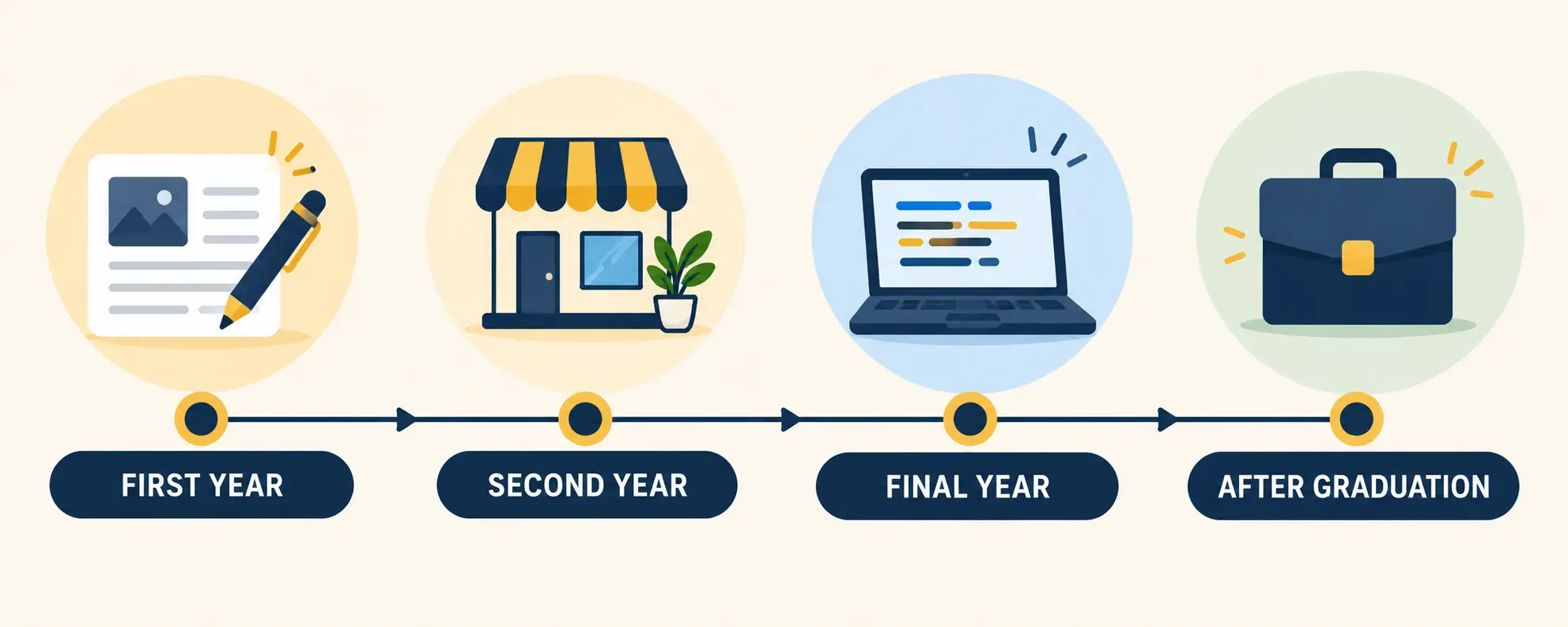
| Stage | What to Do |
|---|---|
| First year of degree | Learn basics free on Google Skillshop. Start a blog or an Instagram page on a topic you enjoy. |
| Second year | Pick one area (SEO, social media or ads). Help a relative’s shop with its Google Business Profile. |
| Final year or semester break | Join a structured course with live projects to sharpen practical skills. |
| After graduation | Apply with three things: degree, certificate and portfolio. |
Students who follow this plan usually walk into interviews with real work to show, which most freshers don’t have.
How Do You Decide? A 5-Question Checklist
Answer these five questions honestly. Your answers point to the right path.
- Do I already have a degree? Yes means a course. No means a degree first, with self-practice on the side.
- Do I need a government job or plan to study abroad? If yes, a degree is required.
- How soon do I need to start earning? Within six months points to a course.
- Can my family support two to three years of fees? If not, a course plus a part-time or distance degree may work better.
- Do I learn better by doing or by reading? Hands-on learners usually do better in practical courses.
| Your Situation | Better Fit | Why |
|---|---|---|
| Just finished Class 12, unsure about career | Degree with digital marketing specialisation + self-practice | Keeps all options open |
| Graduate, looking for a job quickly | Short-term course | Fastest route to proof of skill |
| Working in a non-marketing role | Weekend short course | No career break needed |
| Aiming for marketing manager in 8–10 years | MBA later, after 2–3 years of work | An MBA carries more weight with experience |
| Running a business | Short course or single modules | Direct use in your own business |
| Government job or study abroad goal | Degree | Formal recognition is mandatory |
Common Mistakes Students Make When Choosing
These mistakes cost students time and money every year:
- Treating a certificate as a job guarantee. A digital marketing certification shows you attended. Your portfolio shows you can perform.
- Picking a degree only for its name. Check how many papers are actually digital. Some programmes have just one or two.
- Skipping approval checks for online degrees. If you choose an online or distance degree, confirm the university’s entitlement on the UGC Distance Education Bureau portal before paying fees.
- Choosing the cheapest or shortest course. Low fees mean little if practical hours are missing.
- Waiting until after graduation to practise. Starting a small project in your first year gives you a two-year head start.
- Ignoring AI tools. Employers now expect freshers to use AI tools for research and first drafts, with good judgement.
How to Check Any Digital Marketing Programme Before You Pay
Check four things before paying: the syllabus, practical hours, trainer background and past student work. Use this checklist:
- Compare the digital marketing course syllabus module by module with what job listings ask for.
- Ask how many hours are hands-on versus lecture.
- Ask who teaches and whether they currently manage real campaigns.
- Ask to see sample student projects, not just testimonials.
- Compare fees against duration and support using a guide on digital marketing course fees in Coimbatore.
- Carry a written list of questions to ask before joining a digital marketing course to every counselling session.
Frequently Asked Questions
Is a degree necessary for digital marketing jobs in Coimbatore?
No. Many agencies and small businesses hire based on skills and portfolio. Larger companies and MNCs often list a degree as a minimum, so having one widens your options.
Which is better after Class 12: a degree or a short-term course?
A degree is usually better after Class 12 because it keeps government jobs, higher studies and corporate roles open. You can add practical skills alongside it.
Is an MBA in digital marketing worth it for freshers?
It depends on your goal. An MBA is most useful for management roles and carries more weight after two or three years of work experience. For an entry-level role, skills and a portfolio usually matter more.
How long does a short-term digital marketing course take?
Most courses take two to six months. Weekend batches can take longer, while intensive batches may finish in about three months.
Can B.Com or engineering graduates take a digital marketing course?
Yes. Digital marketing has no fixed stream requirement. Graduates from commerce, science, arts and engineering all switch into it regularly.
Is a digital marketing certification valid for government jobs?
Usually not on its own. Government posts require a recognised degree. A certificate helps mainly in private-sector hiring.
Can I do a short course while studying for my degree?
Yes. Many students take weekend or evening batches during the final year or semester breaks so they graduate with both a degree and practical skills.
Are online digital marketing degrees valid in India?
They are valid when the university holds current UGC-DEB entitlement for that specific online programme. Always check the official UGC-DEB portal before enrolling.
What skills matter most for digital marketing freshers?
SEO basics, Google Ads, social media ads, Google Analytics, content writing and the ability to explain results in numbers. A small portfolio ties these together.
Is digital marketing hard to learn without a marketing background?
No. Most beginners pick up the basics within a few months with regular practice. This beginner-level explanation of whether digital marketing is easy to learn covers what to expect.
So, Which Path Should You Pick?
Start with where you stand today. No degree yet? Get one, and practise digital skills alongside it. Already a graduate? A focused course with live projects will usually get you working sooner. Planning for management roles later? Keep the MBA for after you’ve gained some work experience.
The digital marketing degree vs short-term course question isn’t about which option is better in general. It’s about which one fills the gap in your profile right now. Write down your answers to the five questions above, talk them through with a parent or mentor, and make your choice this week.