
A social media marketing strategy for beginners is a written plan that defines your goals, your target audience, the platforms you will use, the type of content you will create, and how you will measure results. Without a strategy, most beginners waste time posting randomly and see little growth. With a clear plan, even a brand-new account can build a real audience and generate enquiries within weeks.
Social media success for beginners in 2026 comes from doing fewer things well — not from being on every platform. Choose one or two platforms where your audience is already active, post consistently with a clear purpose, engage genuinely with your audience, and review your analytics monthly. A simple strategy you can execute every week beats an ambitious plan that never gets done.
Most people who struggle with social media marketing make the same mistake: they start posting before they have a plan. They pick the wrong platform, create content without a clear audience in mind, post inconsistently, and give up after a few weeks when nothing happens. This guide walks you through building your strategy the right way, step by step, so that your time on social media actually produces results.
Whether you are a student learning digital marketing, a small business owner in India, or someone looking to build a personal brand, this guide applies directly to your situation.
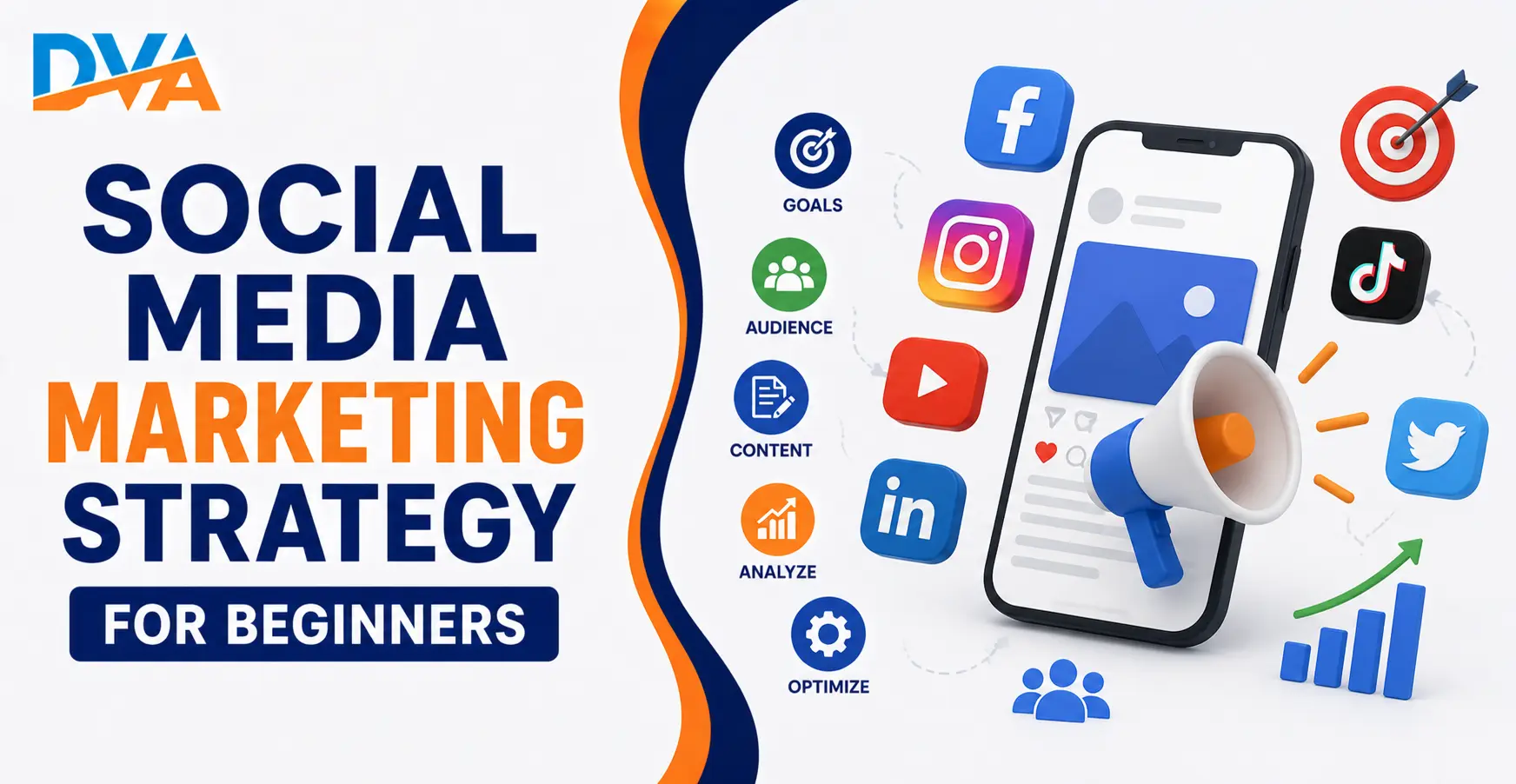
What is a Social Media Marketing Strategy?
Think of it this way. Posting on Instagram without a strategy is like driving without a destination. You might cover a lot of ground, but you probably will not end up where you wanted to go. A strategy gives you a clear destination and a route to reach it.
A good social media marketing strategy answers five questions:
- What do I want to achieve? (Goals)
- Who am I trying to reach? (Audience)
- Where does my audience spend time online? (Platform selection)
- What content will I create and how often? (Content plan)
- How will I know if it is working? (Metrics)
Once you can answer all five, you have the foundation of your strategy. The sections below cover each step in detail.
Step 1 — Set Goals That Are Specific and Measurable
For beginners, common social media goals include:
- Brand awareness: Get more people to know your business or personal brand exists
- Audience growth: Build a following of real, relevant people in your niche
- Website traffic: Drive people from social media to your website or landing page
- Lead generation: Collect enquiries, WhatsApp messages, or email sign-ups from interested prospects
- Community building: Create an engaged group of followers who interact with your content
Pick one or two goals to start. Trying to achieve all of them at once spreads your effort too thin. Most beginners benefit from focusing on audience growth and engagement first, because a large, unengaged audience cannot generate leads. Quality always matters more than quantity on social media.
Step 2 — Define Your Target Audience Clearly
Ask these questions to define your audience:
- Who is my ideal customer or follower?
- What problem are they trying to solve?
- What kind of content do they already follow and engage with?
- What language do they use when they talk about this topic?
- Where do they spend time online?
For example, if you are marketing a digital marketing course in Coimbatore, your audience might be college students in Tamil Nadu who want practical career skills, working professionals looking to switch careers, or small business owners who want to run their own ads. Each of these groups would respond to different types of content on different platforms, which brings us to the next step.
Step 3 — Choose the Right Platforms, Not All of Them
Here is a platform comparison to help you decide:
Digital Vishnu Academy
Join 500+ Students Already Building Their Digital Marketing Career
Live projects. AI tools. 100% placement support. Batches in Coimbatore and online.
| Platform | Best For | Content Type | Primary Audience in India |
|---|---|---|---|
| B2C brands, personal branding, visual products | Reels, Stories, carousel posts | 18–35 age group, urban users | |
| Local businesses, groups, paid ads | Posts, videos, events, groups | 25–55 age group, broad reach | |
| YouTube | Education, tutorials, product reviews | Long-form videos, YouTube Shorts | All age groups, intent-driven viewers |
| B2B, professional services, career content | Articles, posts, carousels | Working professionals, recruiters, B2B buyers | |
| Community building, direct lead nurturing | Broadcast messages, Status updates | Existing contacts and warm leads |
If you are a student or beginner building a personal brand in digital marketing, start with Instagram and LinkedIn. Instagram builds your visual presence and audience. LinkedIn builds your professional credibility and connects you with employers and clients. If you are a local business owner in Coimbatore, Facebook and Instagram together give you the widest local reach.
Step 4 — Decide on Your Content Pillars
For example, if you are a digital marketing professional or student, your content pillars might be:
- Education: Tips, tutorials, how-to guides about digital marketing
- Behind the scenes: Your learning journey, daily routine, tools you use
- Case studies and results: Campaigns you have run, projects you have completed
- Industry news: Updates about platforms, algorithm changes, new tools
- Career insights: Job market trends, skills in demand, interview tips
The 80/20 rule is a useful guide: roughly 80% of your content should educate, entertain, or help your audience, and only 20% should directly promote your product or service. People follow accounts that give them value, not accounts that constantly sell to them. Use tools like Canva AI for social media content creation to design professional-looking posts quickly, even if you are not a graphic designer.
Step 5 — Build a Simple Content Calendar
A realistic posting schedule for beginners:
- Instagram: 4–5 posts per week (2 Reels + 2–3 carousels or single posts)
- Facebook: 3–4 posts per week (mix of text, images, and repurposed content)
- LinkedIn: 2–3 posts per week (articles, text posts, carousels)
- YouTube: 1 video per week (or 1 every 2 weeks when starting out)
Batch your content creation. Set aside 2–3 hours once a week to create all your content for the coming week. This is far more efficient than creating posts one day at a time. Use your phone to capture photos, short videos, and behind-the-scenes moments throughout the week, and then edit and schedule everything in one sitting.
Most social media platforms (Instagram, Facebook, LinkedIn) allow you to schedule posts in advance using their native tools. Meta Business Suite lets you schedule posts for both Instagram and Facebook for free. LinkedIn has a native scheduling feature built into the desktop post editor.
Step 6 — Post Consistently and Engage Genuinely
Engagement matters as much as content creation. When someone comments on your post, reply to them. When you receive a DM, respond promptly. Actively comment on posts by others in your niche. The algorithm on most platforms, including Instagram and LinkedIn, rewards accounts that generate genuine interaction. An account that consistently creates conversations grows faster than one that only broadcasts content without responding.
Do not just post and leave. Spend 15–20 minutes after every post engaging with your audience and the community around your niche. Comment on posts by accounts your target audience follows. Add something genuinely useful to conversations, not just “great post!” This positions you as an active, knowledgeable voice in your space. If you want to understand how social media marketing can build a long-term career, engagement is a core skill you need to develop early.
Step 7 — Track Your Results and Improve Monthly
Key metrics to track for beginners:
- Reach: How many unique accounts saw your content
- Engagement rate: Likes, comments, shares, and saves divided by reach — tells you how interesting your content is
- Follower growth: Are you gaining real, relevant followers over time?
- Profile visits and website clicks: Are people curious enough about your content to visit your profile and click your website link?
- Best-performing content: Which posts got the highest reach and engagement? Create more content in that format.
Every major platform provides free built-in analytics. Instagram Insights, Facebook Business Suite analytics, LinkedIn analytics, and YouTube Studio are all available for free. You do not need a paid tool to get started. Check your top 5 and bottom 5 performing posts each month. Look for patterns. The data tells you exactly what your specific audience responds to, which is more valuable than any generic advice.
Common Mistakes Beginners Make on Social Media
- Being on too many platforms at once. Pick one or two and commit to them. Spreading thin across five platforms produces inconsistent, low-quality content on all of them.
- Posting without a call to action. Every post should guide the reader somewhere: visit your website, send you a DM, comment your answer, save this post for later. Without a call to action, people consume your content and move on without taking any next step.
- Copying what bigger accounts do. Trending formats can inspire you, but your content must be relevant to your specific audience. What works for a celebrity brand in Mumbai may not work for a local business in Coimbatore.
- Focusing obsessively on follower count. 500 engaged followers who regularly comment, share, and enquire are worth far more than 10,000 passive followers who never interact.
- Quitting after 3–4 weeks. Social media growth takes time. Most accounts see meaningful results after 3–6 months of consistent posting. Stopping early is the single biggest reason beginners fail.
- Ignoring analytics. Your analytics tell you what your audience wants. Not checking them means you keep guessing instead of improving based on evidence.
If you want to learn social media marketing professionally and apply a proven strategy with real hands-on practice, our social media marketing course in Coimbatore covers everything from building your strategy to running paid campaigns with real projects.
A social media marketing strategy for beginners does not have to be complicated. Set one clear goal, define who you are talking to, choose one or two platforms where they are active, plan content around 3–5 core topics, post consistently, engage with your audience genuinely, and review your results monthly. That is a complete, working strategy that any beginner can start implementing this week.
Social media is one of the most practical and accessible digital marketing skills to learn. The best way to learn it properly is to practise it with real accounts, real content, and real feedback on what works. If you are looking to build that foundation professionally, our digital marketing course in Coimbatore includes live social media training with hands-on projects from day one.
Frequently Asked Questions
How long does it take to see results from social media marketing?
Most beginners see meaningful results — consistent follower growth, regular engagement, and inbound enquiries — after 3 to 6 months of posting consistently with a clear strategy. The timeline depends on your niche, your posting frequency, the quality of your content, and how actively you engage with your audience. Accounts that post 4–5 times per week and engage daily grow significantly faster than accounts that post occasionally.
Which social media platform is best for beginners in India?
Instagram is the most recommended starting platform for most beginners in India because it has a large, active user base across age groups, supports multiple content formats (Reels, Stories, carousels, and regular posts), and its organic reach for Reels is relatively strong for newer accounts. If your goal is career building or B2B marketing, LinkedIn is the better starting point. Start with one platform and master it before expanding.
How often should I post on social media as a beginner?
For Instagram, aim for 4–5 posts per week. For LinkedIn, 2–3 posts per week is effective. For YouTube, starting with one video per week or even one every two weeks is realistic for beginners. Consistency matters far more than volume. It is better to post 3 times a week reliably for 6 months than to post 20 times in one week and then go silent for a month.
Do I need to spend money on social media ads as a beginner?
No. Organic social media marketing, without paid ads, can produce real results if your content is useful, consistent, and targeted to the right audience. Paid ads amplify results but are not necessary to start. Focus on building your organic presence, understanding your audience, and producing content that gets genuine engagement first. Paid advertising becomes more effective after you understand what your audience responds to organically.
What type of content performs best on social media in 2026?
Short-form video (Instagram Reels, YouTube Shorts, Facebook Reels) consistently outperforms static images on most platforms in terms of reach and new audience discovery. Carousel posts on Instagram and LinkedIn also generate high engagement because they encourage multiple swipes and saves. Educational and actionable content, that teaches your audience something specific and useful, performs better than generic inspirational quotes or promotional content.
Can I do social media marketing without showing my face?
Yes. Many successful social media accounts focus on text posts, carousels, infographics, screen recordings, voiceover videos, and behind-the-scenes content without the creator appearing on camera. However, face-to-camera content does tend to build trust and personal connection faster, especially for personal brands and service businesses. If you are not comfortable on camera yet, start with non-face content and gradually introduce yourself as your confidence builds.
What is the difference between organic and paid social media marketing?
Organic social media marketing means creating and posting content without paying for distribution. Your content reaches your existing followers and anyone who discovers it through shares, hashtags, or the platform algorithm. Paid social media marketing means running ads to reach a broader, targeted audience beyond your followers. Both have value. Organic builds long-term credibility. Paid delivers faster reach and precise targeting. Most effective strategies eventually use both.
Sources and Further Reading
- Meta Business Suite — Free scheduling and analytics for Facebook and Instagram pages
- LinkedIn Marketing Solutions — Official guidance on LinkedIn content strategy and analytics
- YouTube for Business — Official YouTube resources for building a channel and reaching audiences