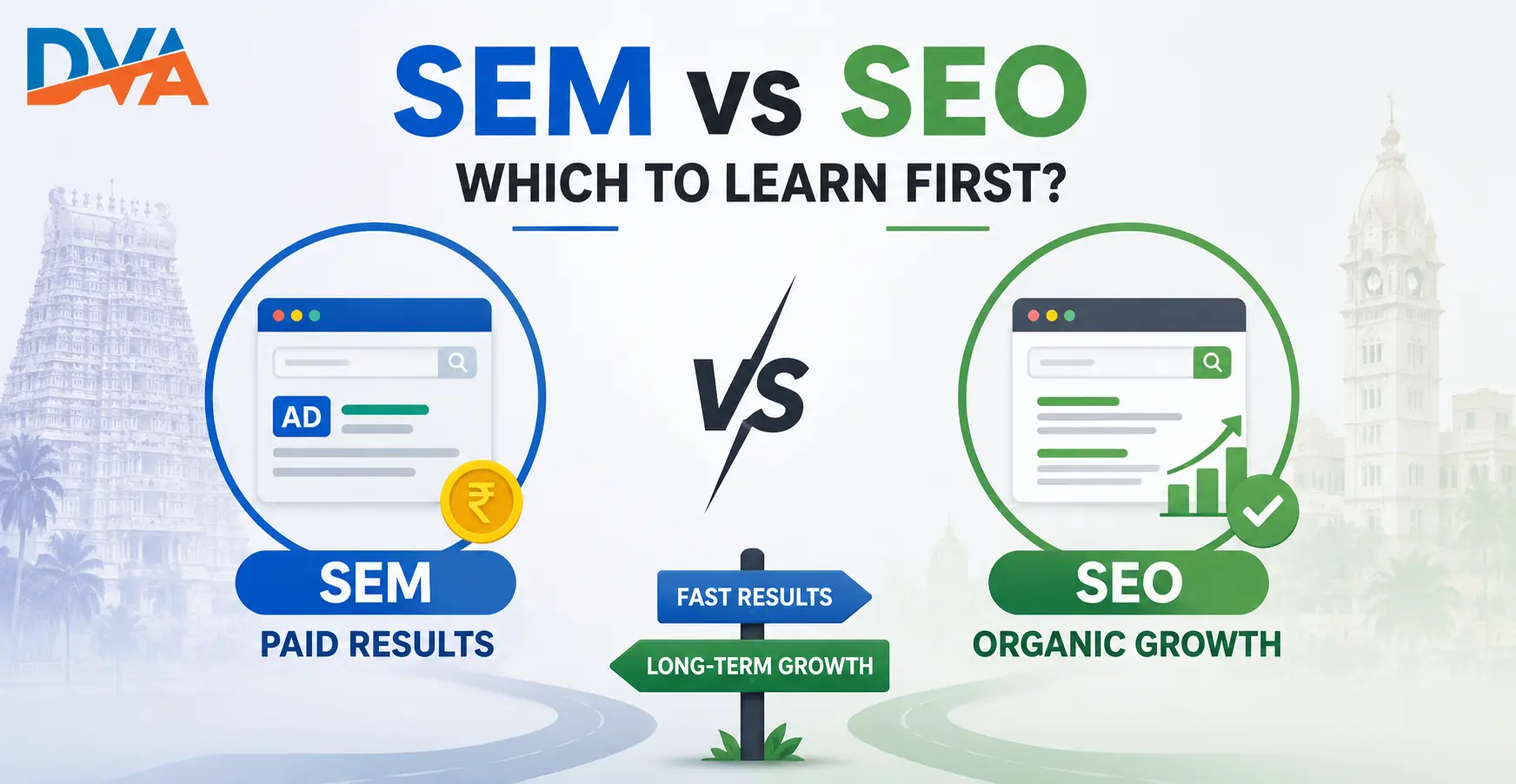
For most beginners, learn SEO first. SEO teaches you the foundational concepts — keyword research, search intent, content structure, and how Google evaluates web pages — that make SEM easier to understand and more effective when you add it later. SEO requires no budget to practise, builds skills that transfer directly to SEM, and has strong entry-level job demand in India. Once you understand SEO, picking up Google Ads (SEM) becomes considerably faster.
SEO and SEM are both strong digital marketing career paths in India. SEO is the better starting point for most beginners because you can practise it without spending money, the fundamentals apply to SEM, and entry-level job demand is high. SEM is the better starting point if you have a specific agency job in mind that runs paid campaigns, or if you want measurable results within days rather than months. Most professionals eventually learn both.
This is one of the most common questions from beginners exploring digital marketing as a career or skill. SEM and SEO both appear prominently in job listings, course descriptions, and digital marketing roadmaps — but they are different skills, have different learning curves, and suit different types of learners.
This guide explains what each involves, how they compare across career scope, learning time, and practical application, and gives you a clear, honest answer on which to learn first based on your goals.
What Is SEO?
SEO has three main areas:
- On-page SEO — Optimising what is on the page itself. This includes keyword placement in titles, headings, and body content; meta descriptions; internal linking; image alt text; and content quality and depth.
- Off-page SEO — Building authority from outside your website. The primary method is earning backlinks — links from other websites pointing to yours — which signal to Google that your content is credible and worth ranking.
- Technical SEO — Ensuring your website is crawlable, fast, mobile-friendly, and structured in a way that search engines can index efficiently. This includes site speed, URL structure, Core Web Vitals, and schema markup.
SEO results are not instant. Depending on your website’s existing authority, competition in your niche, and consistency of effort, meaningful organic ranking improvements typically take anywhere from 3 to 9 months. But once traffic comes in through SEO, it does not stop when you pause a budget — it continues as long as your content remains relevant and competitive.
Our detailed guide on SEO career scope and salary in India 2026 covers the job market, roles, and earning potential for SEO professionals in detail.
What Is SEM?
SEM involves:
- Campaign setup — Choosing campaign objectives, budget, bidding strategy, and geographic targeting inside the Google Ads platform
- Keyword research and match types — Identifying which searches to target and whether to use broad match, phrase match, or exact match for each keyword
- Ad copywriting — Writing compelling headlines and descriptions that earn clicks within the tight character limits of a Google Search ad
- Quality Score optimisation — Improving the alignment between your keyword, ad copy, and landing page so Google charges you less per click and rewards you with better ad positions
- Conversion tracking and reporting — Measuring what happens after the click: did the visitor enquire, purchase, or call?
SEM delivers results immediately but requires an ongoing budget. A well-managed Google Ads campaign can appear at the top of Google search results within hours of going live. The trade-off is that every click costs money, and results pause the moment the budget is exhausted.
For a comprehensive look at the Google Ads career path in India including salaries and certifications, see our guide on building a Google Ads career in India.
What You Actually Learn in Each
Core skills you develop in SEO:
Digital Vishnu Academy
Join 500+ Students Already Building Their Digital Marketing Career
Live projects. AI tools. 100% placement support. Batches in Coimbatore and online.
- Understanding how search engines crawl and index websites
- Keyword research — finding what your audience searches for and why
- Content strategy and writing for search intent
- Technical website analysis (page speed, crawl errors, mobile optimisation)
- Link building outreach and authority development
- Using tools like Google Search Console, Ahrefs, Semrush, and Screaming Frog
Core skills you develop in SEM:
- Google Ads campaign structure (campaigns, ad groups, keywords, ads)
- Keyword bidding strategy and budget management
- Writing ads within strict character limits
- Quality Score improvement and landing page relevance
- Conversion tracking, attribution, and reporting
- Using the Google Ads platform and Google Analytics 4
SEM vs SEO — Full Comparison
| Factor | SEO | SEM (Google Ads) |
|---|---|---|
| Speed to results | 3–9 months for meaningful organic traffic | Immediate — ads appear once campaign is live |
| Ongoing cost | No cost per click. Time and effort investment | Budget required — you pay per click |
| Practice without budget | Yes — practise on any blog or website for free | Harder — real campaign experience needs spend |
| Sustainability | Traffic continues after ranking is achieved | Stops when budget is paused |
| Learning curve | High — broad skill set across content, technical, and links | Medium-high — platform specific with frequent updates |
| Official free certification | None from Google. Third-party options available | Yes — free on Google Skillshop |
| Best for | Long-term organic visibility and brand building | Immediate traffic, lead generation, product sales |
| Freelance potential | High — every website needs SEO | High — every business running ads needs campaign management |
Career Scope — SEM vs SEO Job Market in India
For SEO professionals, roles include SEO Executive, SEO Specialist, Content SEO Writer, Technical SEO Analyst, and SEO Manager. These roles exist across agencies, in-house teams, start-ups, and e-commerce companies. Entry-level SEO positions are available to freshers with practical knowledge, a personal project or blog demonstrating their work, and a basic understanding of Google Search Console.
For SEM professionals, roles include PPC Executive, Google Ads Specialist, Paid Search Analyst, and Performance Marketing Manager. These roles also span agencies and in-house teams, but employers typically expect some campaign experience and a Google Ads certification from Skillshop. The Google Ads Search Certification is free and can be obtained before your first job. The comparison between these career paths is covered in detail when looking at business channel strategy in our post on SEO vs Google Ads for business decisions.
Which Should You Learn First — SEM or SEO?
Learn SEO first if:
- You are a complete beginner with no digital marketing background
- You do not have a budget to run practice ad campaigns
- You want to build a freelance career helping small businesses with content and organic search
- You are interested in content writing, blogging, or website strategy alongside technical marketing
- You have 6+ months before you need to enter the job market and want to build a strong portfolio
Learn SEM first if:
- You are applying for a specific PPC executive or Google Ads role and the employer expects campaign knowledge
- You run or plan to run a business that needs immediate paid traffic
- You have some budget available to practise with live campaigns
- You prefer a structured, platform-based learning path with an official certification (Google Skillshop)
- You want measurable results quickly — paid campaigns show data within hours while SEO takes months
One practical reason SEO is often recommended first is that it forces you to think clearly about keywords and search intent. This skill transfers directly to writing Google Ads headlines and choosing keywords in SEM campaigns. A student who understands why a particular keyword ranks — what the user wanted and how the content answered it — will write better paid ads than one who learned Google Ads in isolation.
Can You Learn Both at the Same Time?
In real job scenarios, the two skills work together rather than separately. A digital marketing team that uses both SEO and Google Ads can test which keywords convert well in paid campaigns, then use that data to guide their SEO content strategy. Or they can identify keywords where organic rankings are already strong and reduce paid spend on those terms, redirecting budget to competitive keywords where organic ranking is unlikely in the short term.
Freelancers who offer both services can take on more clients and command higher rates. A local business in Coimbatore looking for digital marketing support typically needs both: SEO to build long-term local visibility and Google Ads to generate immediate leads while the SEO effort matures.
If you want to learn both SEO and SEM together through structured classroom training with live project practice and mentorship, our digital marketing course in Coimbatore covers both disciplines as part of a comprehensive curriculum. We also offer a dedicated SEM course in Coimbatore for those specifically focused on paid search skills.
SEM vs SEO is not really a competition — both are valuable, both are in demand, and most digital marketing professionals use both. But if you are starting from zero and need to choose one first, SEO gives you a stronger conceptual foundation. It teaches you how Google thinks about relevance and search intent, and that understanding makes every other digital marketing skill easier to learn, including paid advertising.
Start with SEO. Add SEM once you have that foundation. And if you want a structured path that covers both, a good digital marketing course will take you through both disciplines in the right order.
Frequently Asked Questions
Is SEM harder to learn than SEO?
Neither is universally harder — they are complex in different ways. SEO has a broader skill set spanning technical website analysis, content strategy, and link building, which takes longer to master fully. SEM is more platform-specific and requires understanding of Google Ads structure and data analysis, but can be learned faster with a structured approach. Most learners find SEM more immediately measurable since paid campaign results appear quickly, while SEO feedback takes months.
Can I get a job in digital marketing knowing only SEO?
Yes. There are many entry-level and specialist roles for SEO professionals across agencies, in-house teams, and content companies in India. An SEO executive or content SEO writer role does not require Google Ads knowledge. However, candidates who also understand SEM and have a Google Skillshop certification are more versatile and often more competitive when applying for roles at full-service digital marketing agencies that handle both organic and paid campaigns.
Is SEO still worth learning in 2026?
Yes. Organic search remains one of the highest-quality traffic sources for businesses across India and globally. While AI-powered search features are changing how some results are displayed, the fundamental value of ranking well for relevant search queries has not changed. Businesses still invest heavily in SEO because organic traffic, once established, is sustainable and cost-effective compared to paid traffic that requires ongoing budget.
How long does it take to learn SEO well enough to get a job?
With dedicated daily study and practice — building a blog, working on keyword research, analysing rankings, and learning tools like Google Search Console — most beginners can become job-ready for an entry-level SEO executive role within 3–6 months. A structured training course with hands-on projects accelerates this significantly compared to self-directed learning alone.
Do SEM jobs pay more than SEO jobs in India?
Not significantly at entry level — both typically start in the Rs. 2.4–4.5 LPA range for freshers. At mid and senior level, SEM professionals who manage large campaign budgets (Rs. 10 lakh+ per month) tend to command higher salaries due to the direct revenue accountability of the role. SEO professionals at the senior level who can demonstrate measurable organic traffic and revenue growth also earn comparably. The specific company, city, and budget responsibility matter more than the SEO vs SEM distinction.
Do I need to know both SEO and SEM to become a freelance digital marketer?
Not necessarily — you can build a sustainable freelance career specialising in either SEO or SEM. However, freelancers who offer both services are more attractive to small business clients who typically have limited budget and want a single specialist who can handle their complete search presence. Starting with one, becoming genuinely skilled at it, and adding the second after you have clients and income is a realistic and common freelance growth path.
Sources and Further Reading
- Google Ads Help Centre — Official documentation covering SEM campaign types, bidding strategies, and Quality Score fundamentals
- Google Search Console — Google’s free tool for monitoring organic search performance, the primary practical tool for SEO learners and professionals