
TL;DR
In 2026, AI handles speed, scale, and data. Human marketers handle strategy, emotion, and creativity. Neither wins alone. The marketers who come out ahead are those who combine both, using AI as a powerful tool while bringing the human judgment and storytelling skills that AI simply cannot replicate. This guide breaks down exactly where AI leads, where humans lead, and how to position yourself to thrive in an AI-driven marketing world.
Every few months, a new headline appears: “AI Will Replace Marketers.” Then another: “AI Cannot Replace Human Creativity.” So which is true? The honest answer is more nuanced than either side admits. AI vs human marketers is not a simple competition, though in specific areas, it absolutely is.
According to a HubSpot State of Marketing 2024 report, 62% of marketing teams already use AI tools regularly. That number is growing fast. The question is no longer whether AI will affect marketing jobs. The question is how to use this shift to your advantage.
In this guide, we compare what AI does well, what human marketers do better, and exactly what skills you need to stay competitive in 2026 and beyond.
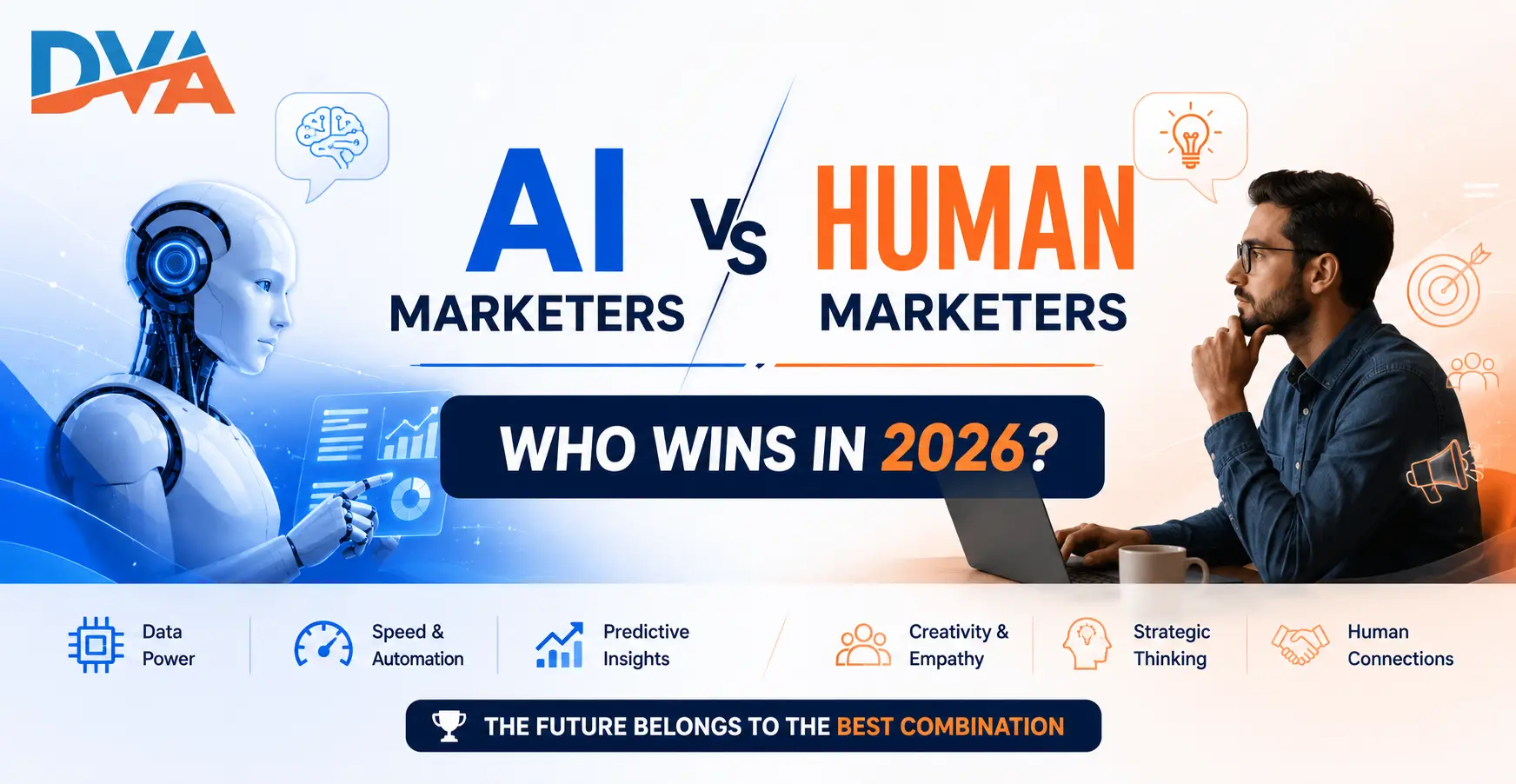
What Can AI Do in Marketing That Human Marketers Cannot?
AI can process millions of data points in seconds, run thousands of A/B tests simultaneously, personalize content for millions of users at once, and operate 24 hours a day without fatigue. These are capabilities no human team can match at the same speed and cost.
AI in digital marketing excels at tasks that need speed, pattern recognition, and scale. An AI tool can analyze a competitor’s entire content library in minutes, identify keyword gaps, predict which ad creative will perform best, and produce hundreds of product descriptions in an afternoon. The same work would take a human team days or weeks.
The key difference is not intelligence. It is throughput. AI does not think better than humans. It processes more inputs, faster, and without losing consistency. For tasks where volume and speed matter more than originality, AI wins decisively.
What Can Human Marketers Do That AI Cannot?
Human marketers bring emotional intelligence, genuine cultural understanding, ethical judgment, and original creative thinking that AI cannot replicate in 2026. A skilled human marketer can sense when a brand message feels tone-deaf in a specific moment, build real trust with a client over time, and tell a story that moves people to act, not just click.
Think about the last brand campaign that genuinely moved you. A sense of belonging. Nostalgia. Inspiration. That kind of work comes from humans who understand human experience from the inside. Artificial intelligence marketing tools can imitate style and structure, but they have no lived experience to draw from. Everything AI produces is ultimately derived from what humans created first.
Human marketers also handle complexity and ambiguity better. A crisis communication response, a culturally sensitive product launch, an ad that walks a delicate line: these require judgment that goes beyond data patterns. AI follows patterns. Humans read the room.
AI vs Human Marketers: Side-by-Side Comparison
Here is a direct comparison of how AI vs human marketers perform across the core tasks in digital marketing today:
| Marketing Task | AI Performance | Human Marketer |
|---|---|---|
| Data Analysis | Millions of data points in seconds | Limited by time and cognitive load |
| Content Generation | Fast first drafts at massive scale | Slower, but more original and nuanced |
| Personalization | Excellent at scale (millions of users) | Deep for individuals, not scalable |
| Emotional Connection | Cannot feel or empathize genuinely | A core human strength. Irreplaceable. |
| Strategic Thinking | Pattern-based, not truly strategic | Adapts to new, unpredictable situations |
| Ad Optimization | Continuous, real-time, no downtime | Manual, periodic adjustments |
| Brand Storytelling | Generic without strong human direction | Authentic and culturally rich |
| Crisis Management | Scripted responses only | Reads the room. Adapts in real time. |
| SEO Optimization | Fast keyword research and suggestions | Better at reading genuine search intent |
| Client Relationships | Cannot build trust or genuine rapport | Core human skill. Cannot be automated. |
Where AI Is Already Outperforming Human Marketers in 2026
In specific, well-defined tasks, AI in digital marketing is not just competitive. It is faster and more consistent than any human team at the same cost. These are the three areas where AI currently leads by a wide margin.
Paid Advertising Optimization
Google Performance Max and Meta Advantage+ use AI to test thousands of ad combinations in real time. No human campaign manager can match the speed of that optimization cycle. AI marketing automation has made manual bid management nearly obsolete for most small and mid-size ad campaigns.
100% Placement Support
Get Placed After Your Digital Marketing Course at DVA Coimbatore
Resume building, interview prep, and direct company tie-ups. Real placements, not promises.
Email Personalization at Scale
AI tools can deliver different subject lines, content blocks, and send times to millions of subscribers based on their individual behavior. Human teams physically cannot operate at that level of granularity. Personalized email campaigns driven by AI generate up to 40% more revenue than non-personalized ones, according to McKinsey.
Content Production at Volume
Product descriptions, social media post variations, meta descriptions, and first-draft blog content can all be produced in minutes using AI. A team of 5 people using AI tools today can produce what a team of 20 managed in 2020. For high-volume, structured content tasks, the productivity advantage is clear and growing.
Where Human Marketers Still Have the Clear Edge
Despite rapid progress in AI, there are marketing areas where human professionals consistently produce better results in 2026. These are not areas where AI is slightly behind. These are areas where AI output is consistently generic, forgettable, or risky without strong human guidance.
Brand storytelling is the clearest example. The campaigns people remember, the brands that build real loyalty, the content that gets shared without any paid push: all of this comes from humans who understand audiences at a cultural and emotional level. AI can write the copy. It takes a human to know whether it actually connects.
Client relationship management is another area where humans cannot be replaced. A business development manager who understands a client’s business deeply, anticipates their needs, and earns trust over years is irreplaceable. In B2B marketing especially, the human relationship is often the product itself.
The Smartest Move: Using AI as Your Marketing Co-Pilot
The marketers winning right now are not the ones who have fully automated their work. They are the ones who use AI for the time-consuming, repetitive tasks faster, then use that recovered time on strategy, creative direction, and relationship-building that AI cannot touch.
Think of AI as a capable assistant that never sleeps, never gets bored, and never makes calculation errors. It handles the research, first drafts, data analysis, and reporting. You handle the direction, the judgment, and the story. That combination is far stronger than either working alone.
Watch this video from Digital Vishnu Academy to see how AI tools are used in real digital marketing work today:
Should Marketers Fear AI in 2026?
No. Marketers should not fear AI. They should be cautious about becoming the kind of marketer who can be fully replaced by AI. The difference matters. A marketer who only writes templated content, runs basic campaigns without strategic thinking, and builds no analytical skill is at real risk. A marketer who understands strategy, interprets data creatively, builds client relationships, and uses AI to work 3x faster is more valuable than ever before.
McKinsey research consistently shows that AI marketing automation replaces specific tasks, not entire roles. The roles that survive and grow are those combining human judgment with AI capability. In marketing, that combination is quickly becoming the baseline expectation, not a bonus skill.
Preparation is the right response. The marketers thriving in 2026 are investing in both AI tools and the strategic, relational skills that give those tools direction. Read more about how AI is changing digital marketing and which specific skills are growing in value as a result.
How to Future-Proof Your Digital Marketing Career Against AI
These five skill areas are genuinely AI-proof in 2026, because they require human judgment, experience, and relationship-building that machines cannot replicate:
- Marketing strategy: Setting goals, choosing channels, defining brand positioning, and making budget decisions. AI models scenarios. A human makes the call.
- Creative direction: Deciding what story to tell, what tone fits the brand, and what visual language will connect with the audience. AI produces options. A human chooses what is right.
- Data interpretation: Reading analytics reports and knowing what the numbers actually mean for the business. Generating a report is easy. Understanding what it signals takes real marketing experience.
- Client communication: Building trust, managing expectations, delivering difficult feedback, and maintaining a strong working relationship over time.
- AI tool proficiency: Knowing how to prompt, direct, and evaluate AI output effectively. This is now a baseline digital marketing skill, not an advanced one.
If you want to build all five of these skills with hands-on practice on real client accounts, the digital marketing course in Coimbatore at Digital Vishnu Academy is built specifically to produce job-ready marketers who can work alongside AI tools confidently from day one.
We also cover the best AI tools for digital marketing as a core part of our curriculum, so every student graduates knowing how to use these tools professionally, not just theoretically.
Who Really Wins: AI or Human Marketers in 2026?
The winner in 2026 is the marketer who uses AI well. AI wins on speed, volume, and data processing. Human marketers win on creativity, empathy, strategy, and relationships. Separately, each has real limitations. Together, they form the most productive combination in marketing history.
The marketing profession is not shrinking because of AI. It is changing. The tasks that are disappearing are the low-skill, repetitive ones. The tasks that are growing in value are the high-judgment, relationship-driven, creatively complex ones. AI vs human marketers is not the right frame. The right frame is: which human marketers are building the skills that AI cannot replace?
Start building those skills with structured, practical training. Visit Digital Vishnu Academy to see how our programs in Coimbatore prepare you for a marketing career where AI is your biggest advantage, not your biggest competition.
Frequently Asked Questions
Will AI replace human marketers in 2026?
AI will replace specific marketing tasks, not entire roles. Tasks like manual data entry, templated content production, and basic ad bid adjustments are already being automated. Roles requiring strategy, creativity, client relationships, and ethical judgment are growing in demand. Marketers who adapt to work alongside AI tools are more valuable in 2026, not less.
What marketing tasks can AI do better than humans?
AI outperforms humans in large-scale data analysis, real-time ad optimization, personalized email campaigns at high volume, keyword research, performance reporting, and producing first-draft content quickly. These tasks benefit from AI’s speed and ability to process large datasets consistently without fatigue.
What can human marketers do that AI cannot do in 2026?
Human marketers excel at brand storytelling, emotional connection, creative strategy, cultural sensitivity, crisis communication, and building genuine long-term client relationships. These require lived human experience, empathy, and situational judgment that AI cannot replicate in 2026 or in the near future.
How should marketers use AI in their work in 2026?
The most effective approach is to use AI for high-volume, repetitive, and data-intensive tasks, then apply human judgment to strategy, creative direction, and client communication. AI removes the production bottleneck. Human marketers provide the direction, quality judgment, and relationship management that gives the output real value.
What AI skills do digital marketers need in 2026?
Marketers should be able to write effective AI prompts, evaluate AI-generated content for quality and accuracy, use AI tools for SEO research and ad optimization, and understand what AI cannot do reliably. Proficiency with tools like ChatGPT, Canva AI, and marketing automation platforms is increasingly listed as a requirement in digital marketing job descriptions across India and globally.