
TL;DR: The digital marketing career path in India moves through four clear levels: Fresher Executive (₹2.5–5 LPA), Specialist (₹5–10 LPA), Senior Specialist (₹8–14 LPA), and Manager (₹10–20 LPA). Most people reach manager level in 3 to 5 years. Specialists who build deep skills in performance marketing, SEO, or analytics get there faster. The path is not automatic. It is skill-driven.
Most freshers starting a digital marketing career path ask the same question within the first six months. How long until I am a manager? What do I need to do to get there?
The good news is that this career has one of the clearest growth paths in any industry right now. You can see exactly what skills you need at each level, what you will earn, and what it takes to move up. No vague waiting periods. No mandatory years sitting in the same role.
Digital marketing jobs in India have grown 30% in the last two years alone. Companies are actively looking for people who can lead campaigns, manage teams, and show measurable results. Managers who can do that are being paid anywhere from ₹10 to ₹20 LPA, with senior specialists in performance marketing crossing ₹25 LPA.
This post walks you through every level of the path. What you do at each stage, what you earn, what skills move you up, and how long it realistically takes.
What Does the Digital Marketing Career Path Look Like?
The digital marketing career path in India has four main levels: Executive, Specialist, Senior Specialist, and Manager. Most freshers start at the Executive level handling basic execution tasks. They move to Specialist after 1 to 2 years by deepening one skill. Senior Specialist comes around year 3 to 4. Manager typically follows at year 4 to 5, once you can lead strategy, manage budgets, and guide a team.
Here is a clear overview of how the path looks:
| Level | Role Title | Years of Experience | Salary Range (India) |
|---|---|---|---|
| Level 1 | DM Executive / Trainee | 0 to 1 year | ₹2.5 to 5 LPA |
| Level 2 | SEO / Ads / Social Specialist | 1 to 3 years | ₹5 to 10 LPA |
| Level 3 | Senior Specialist / Team Lead | 3 to 5 years | ₹8 to 14 LPA |
| Level 4 | Digital Marketing Manager | 4 to 6 years | ₹10 to 20 LPA |
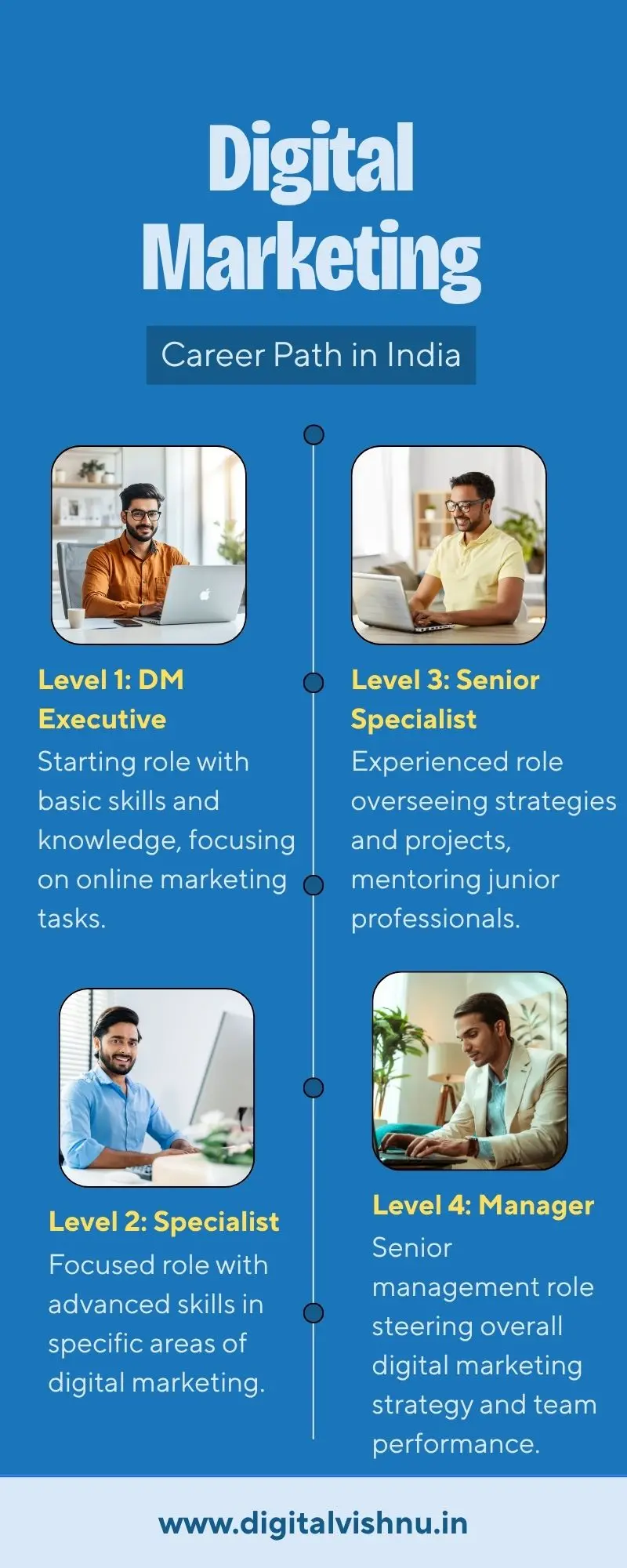
These are not fixed timelines. They are averages. Some people skip Level 3 entirely by delivering strong results early. Others stay at Level 2 for years because they stop growing after the basics. The path is driven by performance, not by calendar years.
Level 1: Starting as a Digital Marketing Executive (0 to 1 Year)
This is where every digital marketing career path begins. As a fresher, your job is to learn by doing. You are not making strategy decisions yet. You are building the muscle memory of execution so that strategy later makes sense.
What you actually do at this level:
- Write and publish SEO-optimised blog posts
- Set up and monitor Google Ads and Meta Ads campaigns
- Schedule and publish social media content
- Pull weekly analytics reports from GA4 and Google Search Console
- Do keyword research and on-page optimisation
- Handle basic email campaigns
Freshers in India at this level earn between ₹2.5 and ₹5 LPA. Agencies pay closer to ₹2.5 to 3 LPA. IT companies and product startups pay ₹3.5 to 5 LPA for candidates who come with real project experience and certifications.
The biggest mistake freshers make at Level 1 is treating it like a job to get through. The ones who move up fast treat every campaign as a learning experiment. They track what worked, ask why, and write it down. That habit is what separates a fast-tracked specialist from someone stuck at executive level for three years.
If you are wondering whether digital marketing is the right starting point, read our guide on whether digital marketing is a good career in Tamil Nadu.
Level 2: Growing into a Digital Marketing Specialist (1 to 3 Years)
At Level 2, you stop being a generalist and pick a lane. You go deep on one skill until companies are willing to pay a premium for it specifically. This is where your salary starts climbing meaningfully.
The three most in-demand specialisations in India right now:
SEO Specialist — You move from basic on-page tasks to technical SEO audits, link building strategies, content gap analysis, and Core Web Vitals optimisation. SEO specialists with 2 years of experience earn ₹5 to 8 LPA. Those who can show measurable ranking results earn more.
Performance Marketing Specialist — You manage Google Ads and Meta Ads budgets independently. You optimise for ROAS, CPL, and CPA, not just clicks. IIDE research shows performance marketing is the highest-paying specialisation in Indian digital marketing, with experienced professionals earning ₹12 to 25 LPA.
Content Strategist — You move from writing content to planning it. Keyword clusters, topic authority, content calendars, and measuring content ROI become your domain. Content strategists with 2 to 3 years of experience earn ₹5 to 9 LPA.
100% Placement Support
Get Placed After Your Digital Marketing Course at DVA Coimbatore
Resume building, interview prep, and direct company tie-ups. Real placements, not promises.
At this level, your salary can jump 40 to 50 percent if you specialise deliberately. upGrad salary data confirms that freshers starting at ₹3.5 to 6 LPA can see that range jump to ₹5 to 10 LPA within two years through focused upskilling.
This is also when building a portfolio of measurable results becomes critical. Not a list of tasks you completed. Actual numbers: the campaign you ran that cut cost per lead by 30%, the blog post you wrote that now ranks on page one, the social ad that delivered 4x ROAS. Those numbers are your ticket to Level 3.
Level 3: Senior Specialist or Team Lead (3 to 5 Years)
Level 3 is the bridge between doing and leading. You are still hands-on with campaigns, but you start owning results for a whole channel or a whole client account. You may begin mentoring juniors. You make decisions without needing approval on every step.
What changes at this stage:
- You own full campaign strategy, not just execution
- You manage junior team members or freelancers
- You present results and recommendations to clients or senior management
- You set channel budgets and make spend decisions
- You evaluate and bring in new tools, AI workflows, or automation
Salary at Level 3 ranges from ₹8 to 14 LPA in India. PayScale data shows that professionals with 3 to 5 years of experience and a strong portfolio of campaign results consistently land at the higher end of this band.
Skills that are now essential: GA4 advanced analysis, marketing automation tools like HubSpot or Zoho, A/B testing, budget planning, and basic reporting for leadership. Companies also start expecting AI tool fluency at this level: using AI for content production, keyword clustering, and campaign analysis.
How Long Does It Actually Take to Reach Digital Marketing Manager?
Most professionals reach the Digital Marketing Manager level in 3 to 5 years in India. The average is closer to 4 to 5 years for people on a standard progression. Some reach it in 3 years by specialising fast and delivering measurable business results early. Others take 6 to 7 years because they stop growing after the execution stage. The timeline is controlled by your results, not your years of service.
Indeed India data shows the average digital marketing manager salary in India at ₹7.17 LPA, with experienced managers at established companies earning ₹12 to 20 LPA. Glassdoor data shows the top 25 percent of digital marketing managers in India earning ₹15 LPA and above.
Managers in Bengaluru earn the most at ₹13.2 to 14.6 LPA on average, followed by Mumbai and Gurugram. In Coimbatore and other Tier 2 cities, manager salaries typically range from ₹8 to 12 LPA with a significantly lower cost of living making the real-world difference smaller than the numbers suggest.
What Skills Separate a Manager from a Senior Executive?
This is the question most people at Level 2 and 3 do not ask often enough. Being good at running campaigns does not automatically make you a manager. The transition requires a specific set of skills that most freshers are never explicitly taught.
Here is what digital marketing managers do that Senior Executives do not:
- Strategy ownership — They decide which channels to invest in, not just how to run them. They look at overall business goals and work backwards to a marketing plan.
- Budget management — They control ad spend across channels and can justify every rupee to senior leadership with data.
- Team leadership — They hire, mentor, and review junior team members. They assign work based on team strengths, not just availability.
- Reporting to leadership — They translate campaign data into business language. Not click-through rates. Revenue impact, lead quality, and pipeline contribution.
- Tool and process decision-making — They evaluate and bring in new tools, build SOPs, and standardise how the team works.
The four skills commanding the highest salary premiums for managers in 2026 are: CRM and marketing automation adds 40 to 60 percent to base pay; performance marketing expertise adds 35 to 55 percent; marketing analytics with GA4 and SQL adds 30 to 50 percent; and AI-driven marketing workflows add 20 to 35 percent.
Understanding what modules build these skills before you start learning helps. Our digital marketing course syllabus guide breaks down which modules map to which career-level skills.

How to Move Up Faster on the Digital Marketing Career Path
The people who move from fresher to manager in 3 years instead of 6 share a few specific habits. None of them are secrets. Most of them just require doing what others skip.
1. Specialise within your first year. Pick one channel. Go deep enough to have a point of view, not just tasks. Generalists stay at executive level longer. Specialists get promoted or poached faster.
2. Track your results in numbers. Every campaign you run, write down what happened. What was the cost per click before you touched it and after? What page did you optimise and where did it rank 90 days later? These numbers are what makes a resume worth reading at the manager level.
3. Learn one analytics tool properly. GA4, Search Console, or the Meta Ads Manager reporting dashboard. Managers are expected to pull data, interpret it, and make decisions. If you wait until you are a manager to learn this, you will not get promoted to manager.
4. Start mentoring before you are asked to. Help the person who joined after you. Explain things. Review their work. This builds leadership credibility faster than any certification.
5. Ask for more responsibility, not just a title. Tell your manager you want to own a campaign end to end, present a client report, or manage the next junior hire. Titles follow accountability. They rarely come before it.
The digital marketing career path from fresher to manager is one of the most achievable progressions in any career today. Companies need managers. They are not easy to find. A fresher who builds the right skills, tracks real results, and starts thinking like a manager before they have the title will get there faster than most people expect.
If you are in Coimbatore and looking at digital marketing jobs in Coimbatore, or want to know what a structured learning path looks like before you start, Digital Vishnu Academy’s digital marketing course is built around this exact career path, with practical training, live projects, and placement support at every stage.
Frequently Asked Questions
How long does it take to become a digital marketing manager in India?
Most professionals reach the Digital Marketing Manager level in 3 to 5 years in India. The timeline depends on how fast you specialise, how well you track and communicate results, and whether you actively build leadership skills along the way. Some reach manager level in 3 years by focusing on high-demand specialisations like performance marketing or SEO and delivering measurable business results early.
What is the salary of a digital marketing manager in India in 2026?
The average digital marketing manager salary in India is ₹7.17 LPA according to Indeed. Experienced managers at established companies earn ₹10 to 20 LPA. The top 25 percent of managers earn ₹15 LPA and above according to Glassdoor. In Bengaluru, the average is ₹13.2 to 14.6 LPA. In Coimbatore and Tier 2 cities, the range is typically ₹8 to 12 LPA with a lower cost of living.
What skills do I need to become a digital marketing manager?
To move from executive to manager, you need to go beyond campaign execution. Key skills include full-channel strategy ownership, budget management, team leadership, advanced analytics, and the ability to present results to senior leadership in business terms. Marketing automation tools like HubSpot and AI-driven workflows are increasingly expected at the manager level in 2026.
Can a fresher become a digital marketing manager without an MBA?
Yes. Digital marketing is a skills and results-based field, not a degree-based one. Most companies hiring managers look for demonstrated campaign performance, a track record of measurable results, and leadership capability. An MBA is not required and is rarely listed as a mandatory qualification in digital marketing manager job descriptions in India.
Which digital marketing specialisation leads to the highest salary at the manager level?
Performance marketing (Google Ads and Meta Ads management for paid campaigns) consistently produces the highest salaries in India, with experienced professionals earning ₹12 to 25 LPA. Marketing automation and CRM skills add the highest salary premiums at 40 to 60 percent above base. Analytics skills using GA4 and SQL also command a 30 to 50 percent premium over generalist digital marketing managers.